Tampilkan postingan dengan label RUSSIA. Tampilkan semua postingan

Rabu, 27 Januari 2016

RUSSIA SPARKS DIPLOMATIC INCIDENT WITH GERMANY OVER 'COVER-UP' OF TEEN RAPED.


RUSSIA is turning the alleged rape of a teenager in Berlin by "Arabic looking men" into a diplomatic incident.


Vladimir Putin and Angela MerkelGETTY
Russia has accused German police of covering up a teen raped by Arabic men
The Kremlin accused Germany of "covering up reality in a politically correct manner for the sake of domestic politics" the alleged rape of a 13-year-old girl identified only as Lisa.
The student from Berlin-Marzahn was reported missing on January 11. She resurfaced 30 hours later and filed a police report claiming to have been abducted by three men at a railway station in eastern Berlin, Russian government officials claim.
Lisa, the child of Russian immigrants in Berlin, says she was taken to an apartment where she was "beaten and sexually assaulted" by men speaking "broken German".
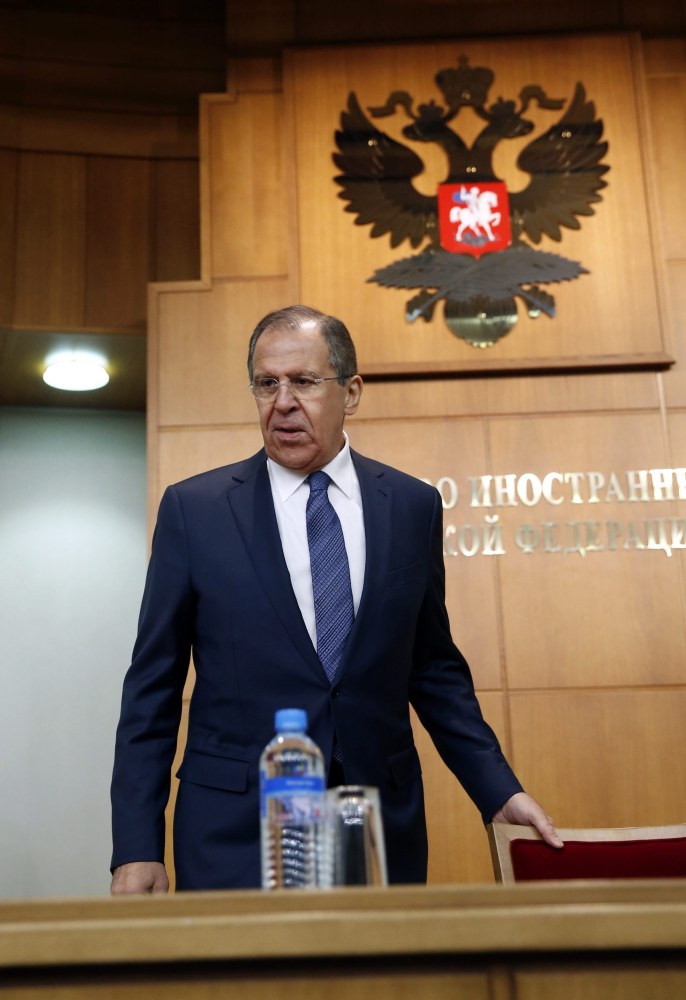
Russian Foreign Minister Sergei Lavrov said: "I hope there will be no repeat of cases like that with our Lisa. It's completely clear that she didn't disappear voluntarily for 30 hours."
But Berlin police furiously deny this version of events. They say that she DID go missing - but that any sexual contact she had seems to have been consensual.
"We cannot say more out of respect for the girl and her family and the privacy of all," said a spokesman. Berlin prosecutors are investigating the incident.
Martin Steltner, a spokesman for the prosecutor's office, said there were only indications of "consensual sexual contact."
The age of consent in Germany is 14. He didn't comment on whether he would investigate the alleged perpetrators for having sex with a minor.
The protests in GermanyCORBIS
Hundreds demonstrated against violence and for more security in Germany after the alleged rape
German protestsCORBIS
Banners read 'We're against the refugees' and 'Lisa we're with you'
It's completely clear that she [Lisa] didn't disappear voluntarily for 30 hours
Sergei Lavrov, Russian Foreign Minister
But the damage seems to have been done in terms of relations with Russian immigrants in Germany.
The case triggered fury, with Russian media and members of the far right accusing police of attempting to cover up crimes committed by refugees.
Some drew comparisons with German police's initial silence after sex attacks on hundreds of women in Cologne on New Year's Eve - most of which were allegedly committed by men of North African and Arab origin.
Over the weekend thousands of Russians protested in various towns, including 700 in Berlin who turned up to a demonstration outside Chancellor Angela Merkel's office.
The crowd held banners reading: "We're against the refugees" and "Lisa we're with you".
Russian Germans protested in Berlin over the weekend, calling for their children to be protected from "migrant violence."
Protests after the Cologne NYE attacksGETTY
Some drew comparisons with German police's initial silence after sex attacks on women in Cologne
They were backed by supporters of "Bärgida," the Berlin branch of the anti-immigrant Pegida movement.
Lisa's aunt told a Russian TV channel that "an Arabic looking man" kidnapped her on January 11. It is further alleged that, with two accomplices, she was thrown on to a bed and raped for 30 straight hours.
In the days following the girl's disappearance, pro-Kremlin channel NTV added: "In Germany and in Sweden, residents are regularly raped by refugees... but the local authorities and police hide these facts and do not open criminal investigations."


Selasa, 26 Januari 2016

RUSSIA DENIES OFFERING ASYLUM TO SYRIA'S ASSAD.

 Russia's Lavrov Denies Offering Asylum to Syria's Bashar Assad

Russia has not asked Syrian President Bashar Assad to step down, nor has it offered him political asylum if he quits, Foreign Minister Sergey Lavrov said Tuesday.
The denial came as the Kremlin's top diplomat faced questions from reporters about Moscow's international relations, including its role in Syria peace talks and the Ukraine conflict.
Asked about reports that Russia had demanded Assad stand down in exchange for asylum, Lavrov responded: "In both cases, the answer is: 'No'. This is untrue ... No one asked about political asylum, and no one offered anything of the kind."

In opening remarks, Lavrov pledged that Russia would continue to pursue an "independent" foreign policy and said Russia's military intervention had brought a "clearer picture" to Syria's civil war.
"We have helped to break the trend in the country and narrow the area controlled by terrorists," he said, referring to armed opposition groups backed by the West.
He also called for Kurds to be invited to forthcoming peace talks on Syria, calling their absence "unfair."
Image: Russian Foreign Minister Sergei Lavrov gives a news conference
Sergei Lavrov called for a reset in relations with Washington. YURI KOCHETKOV / EPA
"How can one talk about political reforms in Syria while ignoring the main Kurdish political party? If we fail to invite this group it will be a grave mistake," Lavrov said. "It is unacceptable to play to the hand of the single member of the UN Security Council that decided to leave the Kurds behind."
Without naming countries, he said it was "capricious" that some parties in the peace talks had refused to negotiate, and criticized demands — made by countries including the U.S. — that Assad stand down as part of any deal.
"When there are attempts to put conditions for collective fight against terrorism, conditions that are irrelevant, such as 'if you agree to a regime change, for example, in Syria, then we will for real begin to fight terrorism collectively' ... that is, I believe, the biggest mistake," Lavrov said.
He also called for a new "reset" in relations between Russia and the United States, which plunged after the Ukraine crisis, but said there was no question of returning Crimea to Kiev control.
Lavrov also poured scorn on last week's ruling by a British judge that Russian President Vladimir Putin had "probably" sanctioned the killing of political foe Alexander Litvinenko, who was murdered by nuclear radiation poisoning in a London hotel in 2016. The finding could seriously damage relations with the U.K., Lavrov said.


Sabtu, 23 Januari 2016

'LIKE STEPPING INTO A NOVEL' 

 St Petersburg in winter: 'Like stepping into a novel'

St Petersburg, the setting for key scenes in the BBC's dramatisation of 'War and Peace', is at its best under a blanket of snow


St Petersburg in winter: 'Like stepping into a Russian novel'
St Isaac's Cathedral Photo: AP/FOTOLIA
On the edge of a frozen lake, somewhere outside St Petersburg, I am stretched out on the wooden racks of a rickety banya, or sauna. Clouds of steam part to reveal several lobster-pink Russians on the racks below. Some maniac has just thrown a bucket of water on to the hot stones in the corner, and the temperature – already somewhere between gas mark 8 and Dante’s Inferno – rises dramatically. I feel my bone marrow is melting. Meanwhile, my new best friend, Seva, is whipping me with birch twigs – “For improving circulation,” he grunts.
Russian banya are the Baltic equivalent of ginseng; they cure everything: liver complaints, skin conditions, muscle ache, sexual dysfunction, broken hearts, spiritual unease. They are an integral part of the Russian winter, for the thing about the banya is you need a freezing lake to get the full benefit. The door opened momentarily. Snow wafted in as two enormous men set off at a canter, clutching tiny bath towels, down an icy path to where a hole had been cut in the ice of the lake.

 In our islands, most of us don’t get a great deal of winter. We get rough weather, especially this year, but not proper winters – frozen lakes, white sculptural landscapes, startling blue skies, snowdrifts groping the windowsills, a dry, sharp cold that crackles and snaps and presses your nostrils. In real winters, your breath plumes into the air like a steaming kettle, and the blood starts to pump. A proper winter is not just ravishingly beautiful, it is exhilarating. Winter is St Petersburg’s natural season. Perched on the edge of the Gulf of Finland barely 500 miles from the Arctic Circle, the one-time Russian capital is at its most beautiful when the snow starts to swirl. The Neva River is a wilderness of ice, and in the squares of black, bare trees the winter light is pale and watery. Along the frozen canals and the wide avenues there is a muffled stillness.
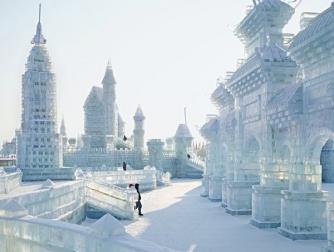
 
St Petersburg in winter: 'Like stepping into a Russian novel' 
Ice on the Neva River  Photo: AP/FOTOLIA

St Petersburg is the city where everyone looks fabulous in furs and rosy cheeks. As the afternoons draw in, the fat globes of the street lamps blossom along the Nevsky Prospect, and the frosted windows of the shops glow invitingly. In Theatre Square ballet fans hurry towards the brightly lit Mariinsky Theatre, where Nijinksy and Nureyev both performed; its season begins in autumn and runs through the winter. Across the city, frost patterns decorate the windows of the Winter Palace. Not far away, the great dome of St Isaac’s hovers like a vision in the early dark, while the statue of Peter the Great rearing on his horse above the bare trees carries a mantle of snow around his shoulders.


"St Petersburg is the city where everyone looks fabulous in furs and rosy cheeks"
St Petersburg is not an old city, or an Asian one, like Moscow. It was built to be Russia’s window on the West. In the spring of 1703, Peter the Great, flush from victory over the Swedes, got down from his horse in the marshes that bordered the Neva River and cut two slices of turf with his bayonet. Laying them in the form of a cross, he announced, here there shall be a city.


So began the 18th century’s most extraordinary building project. A quarter of a million serfs, soldiers and prisoners of war were press-ganged into Peter’s grand new project. Millions of logs were floated down the Neva, and stone work was forbidden elsewhere in Russia so that the nation’s supplies could be diverted here.
St Petersburg in winter: 'Like stepping into a Russian novel' 
The Peter and Paul Fortress, where the Romanovs kept political prisoners in medieval conditions  Photo: AP/FOTOLIA

The nobility was commandeered, too. A thousand of Russia’s best families were ordered to construct houses and palaces in the new city. In muddy fields and clapboard towns across the sprawling distances of Siberia, peasants listened to tales of how Peter was creating his city in the heavens then lowering it down to earth. Within 50 years, St Petersburg was one of the most sophisticated and opulent cities in Europe. Palaces and academies, cathedrals and theatres, ministries and state institutions lined the avenues and canals as they radiated from the golden spire of the Admiralty. Peter’s new capital, his window to the West, had turned its back on its creaky empire and on “Asiatic” Moscow.


Seva was born in St Petersburg and would never live anywhere else. I met him through mutual friends and he guided me around the city he loves. “Peter,” he said – he had the curious habit of calling the city by this single name – “we are always falling in love with Peter. It is a city of romance.” An artist, a bohemian, a romantic, Seva could have been the archetypal St Petersburg citizen.


Real and imagined, romantics have always loomed large in Peter’s life. For instance, it was in St Petersburg that Anna Karenina fell in love with Count Vronsky . Tchaikovsky studied at the St Petersburg Conservatory and conducted the premiere of his Sixth Symphony in the city only nine days before his death; he is buried in the Tikhvin Cemetery alongside other St Petersburg romantics – Borodin, Mussorgsky, Rimsky-Korsakov and Dostoevsky. But it was Pushkin, the great Russian poet, who set the bar for gallant St Petersburg romantics, conducting numerous love affairs and fighting no less than 28 duels. He succumbed in the 29th, fatally injured by a man he accused of trying to seduce his wife. His seconds carried his body to his home on the Moika River Embankment. It was midwinter.

St Petersburg in winter: 'Like stepping into a Russian novel'F
Fog envelopes one of St Petersburg's parks  Photo: AP/FOTOLIA

Russian winters have made St Petersburg a world of interiors and, with 500 palaces in the city, many are magnificent. Step inside the double doors, shed the overcoat and fur hat, and you enter a world of sweeping staircases and gilded moulding, of forests of chandeliers and ballrooms measured in acres, of battalions of nude statues and regiments of headscarfed babushkas with mops trying to keep up with the cleaning.


In the Yusupov Palace, you can follow the assassination of Rasputin by the cross-dressing Prince Felix or attend a concert in the tiny rococo theatre.
The best of the palaces are a carriage’s drive from the city – Peterhof, Tsarskoye, Pavlovsk, the Catherine Palace. To see them in winter when snow drifts across the parklands is to step into the pages of a Russian novel – as we shall witness when the BBC’s spectacular adaptation of War and Peace airs tomorrow night (some scenes were shot on location at Catherine Palace itself).


But the mother of St Petersburg’s palaces is the Winter Palace, a building that would make Buckingham Palace seem cramped. There are said to be 1,500 rooms and 117 staircases. Its excess reflected that of its creator, the Empress Elizabeth, daughter of Peter the Great, who ruled Russia for 20 years in the mid-18th century. Her wardrobes were said to be stuffed with more than 15,000 frocks while her floors were littered with unpaid bills. When construction costs ran 300 per cent over budget, she ordered a series of beer halls to be built across Russia to finance the shortfall, knowing she could rely on peasants to drink her back to solvency.
But let’s bypass the endless swank of Russian aristocracy and the stunning private apartments, many with a view across the Neva to the Peter and Paul Fortress where the Romanovs kept political prisoners in medieval conditions. Let’s head, instead, for the little museum tucked into several adjoining wings.

The Hermitage seems to reflect the scale of Russia – 6.5 million square miles across 10 time zones. Apparently you would need nine years to spend just a few moments in front of each of its exhibits, assuming you paused occasionally to eat and sleep. Catherine the Great was responsible for the nucleus of the vast collection; her artistic appetites seemed to be as impressive as her sexual ones. There are Egyptian collections, Near Eastern, Classical, Renaissance. But it is the paintings that really overwhelm – this is the largest collection in the world. Interested in Rembrandts? You will see some of his best work. Keen on Matisse? You’re in for a treat.


But it is winter: don’t get stuck indoors. Some of the best ice hockey teams are over at the Ice Palace. There is sledding, tobogganing, sleigh rides, cross-country skiing. And there are the Russian banya. Seva is an enthusiast. “Whatever is ailing,” he says, “banya is the cure.” We take a taxi to a frozen lake on the outskirts. A rickety hut is perched on the shore, with two tin chimneys belching woodsmoke. Disrobing in a side room, we follow an attendant through to the hot room. A couple of strapping women shuffle along a bit and Seva and I hunker down among the fleshy bodies. Despite the sweltering conditions, everyone is in a jolly mood and a woolly hat – the Russians believe extreme heat is bad for exposed hair.

St Petersburg in winter: 'Like stepping into a Russian novel' 
The Petersburg plunge: winter swimmers prepare to take an icy dip  Photo: AP

After 20 minutes of sweating like a self-basting turkey, I follow Seva outside into the Russian winter. Wearing nothing but small towels, we scamper along the frozen path to the end of a dock on the lakeshore. A set of steps leads down through the hole cut in the thick ice. A rope has been thoughtfully laid on so that we might have something to hang on to as our vital systems shut down.


Taking a deep breath, I lower myself into the water. For a moment I can’t feel anything; my body is numb with shock. Then the cold hits me, so cold that my body seems to be burning. We shoot back out of the lake as if there were a trampoline beneath the water and flee along the ice path to the enveloping heat of the banya. The endorphins are buzzing.
Back inside, Seva claps me on the back and smiles broadly. “Winter,” he says. “Bracing, eh?” That’s Russian understatement. Winter in St Petersburg is more than bracing.
It is beautiful, it is exciting and, down here at the banya, the sharp smack of a proper winter is absolutely exhilarating.
War and Peace continues next Sunday at 9pm on BBC One

St Petersburg essentials

British Airways Holidays (0344 493 0125; ba.com) offers three nights at the five-star Rocco Forte Hotel Astoria from £299 per person, for departures between January 8 and 28. This includes return flights from London Heathrow and accommodation with breakfast. Book by January 9.
Other tour operators that can arrange packages to St Petersburg include Cox and Kings (coxandkings.co.uk) and Kirker (kirkerholidays.co.uk).
For our detailed guide to the city, including hotel and restaurant recommendations, see the telegraph.co.uk/petersburg website.
British citizens need a visa to visit Russia – see ru.vfsglobal.co.uk for applications.

Telegraph Travel Show

Plan your next great adventure at the inaugural Telegraph Travel Show at the ExCeL London. Book a free session with one of our travel experts at the Genius Bar, or be inspired by Levison Wood, Monty Halls and Will Greenwood who will be among the celebrity speakers on stage. Meet over 200 exhibitors – from leading tour operators and cruise lines to the best tourist boards – who will be offering insights, tips and exclusive show-only offers or sample exotic food and fine wines from around the world. The event takes place at the ExCeL London.


SYRIAN GOVERNMENT THANKS RUSSIA FOR HEL CAPTURING KEY TOWN.

 Syrian government thanks Russia for help capturing key town


 SALMA, Syria (AP) — Pictures of Syrian President Bashar Assad hang on nearly every building in the town of Salma, which government troops captured last week in one of their most significant advances since Russia intervened militarily on their side.

 The Syrian government offensive has given Assad a stronger hand going into peace talks with the opposition that are planned for next week in Switzerland.


The Russian military on Friday took Moscow-based reporters to see the town in Latakia province, which had been out of government control for more than three years. Most of the buildings bore visible signs of fighting, with holes in concrete walls gaping open and windows blown out.
Government forces were able to capture the city "thanks to the support of the friendly Russian aviation," Latakia Governor Ibrahim Khder al-Saalem said. "Our army will now press its offensive further."
Since Russia launched its bombing campaign on Sept. 30, its warplanes have flown nearly 6,000 missions in support of the Syrian government troops. The airstrikes were ostensibly to target Islamic State militants and other extremists, but they also have helped Assad push back rebels on several fronts and capture dozens of villages in the north and west


While Salma had been under rebel control since 2012, the government had continued to hold most of the rest of Latakia province, the heartland of Assad's minority Alawite sect. Salma, a town of 10,000, sits on hills overlooking the Mediterranean coast, about 40 kilometers (25 miles) away.
The governor said the militants who had held Salma burned 200 hectares (500 acres) of apple orchards and 300 hectares (750 acres) of forest around the city before retreating toward Turkey. The border with Turkey, a key supporter of rebels in the area, is only 12 kilometers (seven miles) away.
On Friday, Syrian troops captured more areas from insurgents in Latakia province, including Kaluksi mountain and several other villages, according to the state-run SANA news agency.
The Britain-based Syrian Observatory for Human Rights reported heavy clashes in the mountains of Latakia province, saying that the Syrian army and pro-government forces were advancing in the area.
The hills around Salma were littered with blown-up tanks and other vehicles. Russian Defense Ministry spokesman Maj. Gen. Igor Konashenkov said Russian planes had helped destroy military vehicles and bunkers placed in strategic positions, helping prepare the way for the Syrian army to capture the city. He said the area had many ammunition depots, holding massive caches of explosives, which also were targeted by Russian warplanes.
Syria's five-year civil war has killed a quarter of a million people, displaced half the country and enabled the radical Islamic State group to seize a third of Syria's territory.
The talks planned for next week in Geneva are meant to start a political process to end the conflict, which started in 2011 as a largely peaceful uprising against Assad's rule but escalated into an all-out war after a harsh state crackdown. The plan calls for cease-fires in parallel to the talks, a new constitution and elections in a year and a half.
Before the fighting began, Salma was a popular spot in the summer with people seeking a respite from the heat. On Friday, life was returning to the city, with doctors standing outside the local clinic and police officers gathering at their station, which was adorned with a multitude of Assad portraits.


CAMERON : UK AND RUSSIA CAN TALK SYRIA DESPITE TENSIONS.


Britain's government should not shy away from talking to Russia about peace in Syria, though relations with Moscow are strained, Prime Minister David Cameron told Al Jazeera.
A British inquiry on Thursday said that Russian President Vladimir Putin "probably" approved the assassination of ex-KGB agent Alexander Litvinenko in London, increasing tension between Russia and the UK.
Obviously we have real difficulties with our relationships with Russia because of what has happened.
British Prime Minister David Cameron
Judge Robert Owen said it was likely the Russian leader signed off the killing of the former spy in 2006 after a long-running feud.
"There is no doubt that when it comes to Syria that we need all of the players, whether it is Saudi Arabia or Iran or Russia. Everyone needs to be involved," Cameron said in a wide-ranging interview with Al Jazeera on the sidelines of the Davos summit. 
"Obviously we have real difficulties with our relationships with Russia because of what has happened and it is right we take the action we announced yesterday, but when it comes to Syria, difficult as it is, we have to discuss these issues with them because the crisis will only be solved when all the players recognise that it is in their interest to have a settlement," he added.


UN-backed talks between the Syrian government and opposition are scheduled for Monday, though officials have said they might be briefly delayed.
When asked whether Britain would agree to accept more refugees as the crisis in the Mediterranean continued, Cameron said his government did not want to incentivise people to travel to the UK.
"We said we will take 20,000 refugees from the Syrian refugee camps in Jordan, Lebanon and Turkey. We don't want to provide an extra pull factor into Europe. We said we will resettle a thousand by Christmas and we did that," Cameron said.


Jumat, 22 Januari 2016

THE MOMENT RUSSIA WENT FULLY ROQUE.

Poisoning a British citizen on British soil crossed a line—and presaged nearly a decade of bad behavior.
The grave of ex-KGB agent Alexander Litvinenko in London Toby Melville / Reuters
In many ways it all began with the assassination of Alexander Litvinenko.
Not that Vladimir Putin’s Russia was exactly a model global citizen before the November 2006 killing of the former KGB spy who defected to Great Britain. But when Litvinenko was lethally poisoned after drinking tea laced with polonium in a London hotel in November 2006, it heralded Russia’s transformation from being a mere international pain to being a full-blown outlaw state.
An official British investigation into the incident has now concluded that former KGB bodyguard Andrei Lugovoi and his accomplice Dmitry Kovtun killed Litvinenko, most likely with Putin’s approval. (Both men have denied the charges.) And that was the moment when Russia fully went rogue. It was the point where the Kremlin stopped even pretending to play by international rules. It was the point where Moscow’s gangster state truly went international.
In fact, at the time he was killed, Litvinenko was preparing to testify in a Spanish investigation into ties between Vladimir Putin’s inner circle and Russian organized-crime groups operating in Europe. And after Putin’s agents allegedly whacked a British citizen on British soil and got away with it, Russia started breaking bad.
Months later, in April 2007, came Russia’s cyber attacks on Estonia that hit that country’s parliament, banks, and government ministries. And the following year, in August 2008, came the invasion of Georgia.


Litvinenko’s killing was also a prologue to the more recent litany of bad behavior and law-breaking: the little green men and the annexation of Crimea, the hybrid war in the Donbas, and the downing of Flight MH17 by Moscow-backed separatists.
It was a harbinger of Moscow’s new fondness for hostage-taking, a wave that has seen Estonian law-enforcement officer Eston Kohver, Ukrainian Air Force pilot Nadia Savchenko, and Ukrainian filmmaker Oleh Sentsov kidnapped from their home countries and hauled before show trials in Russia to face ridiculous charges.
It was a prelude to the recent wave of cyberattacks on targets including a French television network, a German steelmaker, the Warsaw stock exchange, The New York Times, the U.S. House of Representatives, the U.S. State Department, and the White House.

The British investigation, which concluded that Litvinenko was “probably” killed on Putin’s personal order, is important because it provides by far the most damning confirmation of a link between the assassination and the Kremlin’s inner sanctum. It gives an official imprimatur to what has long been widely suspected. It reminds us of the utter outrageousness of what happened nearly a decade ago.

There were, of course, signs before Litvinenko’s killing that Putin’s Russia was headed for the dark side. A month earlier, investigative journalist and Kremlin critic Anna Politkovskaya was gunned down in the stairwell of her Moscow apartment building—on Putin’s birthday. And in 2004, Russia brazenly interfered in Ukraine’s presidential election, and is widely suspected of being involved in the poisoning of the eventual winner, Viktor Yushchenko. There was also the February 2004 assassination of Chechen separatist leader Zelimkhan Yandarbiyev in the Qatari capital, Doha.
But the Litvinenko killing—which was described by a lawyer for the London police as “a nuclear attack on the streets of London”—crossed a line.
Nine years and two months ago, Putin learned that he could get away with murder—even of foreign citizens on foreign soil. And we’ve been living with the consequences ever since.

Rabu, 20 Januari 2016

PUTIN: EUROPE'S JEWS SHOULD MOVE TO RUSSIA

Russian President Vladimir Putin, center, with representatives of the European Jewish Congress after a meeting in the Kremlin on Tuesday. (Pool photo by Mikhail Klimentyev/Sputnik/Kremlin via AP)

Russian President Vladimir Putin proposed Tuesday that Jews facing a rising tide of anti-Semitism and bigotry farther west should move to Russia, where he said they would be better accepted.
The Russian leader was in a meeting with members of the European Jewish Congress, an organization headquartered in Paris. Its Moscow-born president, Moshe Kantor, had detailed to Putin how anti-Semitic attacks had risen in Europe by about 40 percent each of the past three years and that Jews can no longer walk the streets of some major European cities in safety.
"They should come here, to Russia. We are ready to accept them," Putin said in response, according to a transcript provided by the Kremlin.
Kantor appeared a bit taken aback by the gesture, but Putin continued, "They left the Soviet Union; now they should come back."
The remarks come at a time of pronounced fear among Europe's Jewish communities, rattled both by a rise in far-right activism across the continent as well as an influx of Muslim migrants and refugees.
About 10,000 Jews from Western Europe immigrated to Israel in 2015 — a record figure, according to the Jewish Agency. The bulk of that number came from France, which is home to Europe's largest Jewish population. A brutal machete attack last week on a Jewish religious teacher in the city of Marseille sparked concerns about the safety of Jews wearing kippas, or skullcaps, in public.

 Russia, of course, has its own long and terrible history of anti-Semitic bigotry and pogroms. As the U.S.S.R. crumbled, hundreds of thousands of Soviet Jews used the opportunity to leave. Between 1989 and 2006, according to Russia Today, some 1.6 million Soviet Jews and their relatives opted to move to Israel, while 325,000 migrated to the United States, and roughly 219,000 to Germany.


WHEN RUSSIA'S MONEY RUNS OUT, THE REAL TROUBLE STARTS.

 Bill Browder, Hermitage Capital Management


Stuck in a recession and with no sign of a reprieve in the oil price, Russia could quickly descend into chaos if the money runs out, William Browder, a well-known critic of the Kremlin and chief executive of Hermitage Capital, told CNBC.
"I don't think you can underestimate how bad the situation in Russia is right now, you've got oil below any measure where the budget can survive and you've got sanctions from the West. Russia is in what I'd call a real serious economic crisis," he said on Thursday.
Speaking to CNBC in Davos where global business and political leaders are attending the World Economic Forum (WEF), Browder said the central bank of Russia was "running out of money."
"Let's say that they have $200 billion (in reserve) and they're burning through all sorts of money right now because of the oil prices and sanctions. They just don't have the money to support the ruble and so Russians are just suffering," he said, adding.

"Eventually they're going to run out of that money and when they do, that's when the real trouble begins," he added.
Browder was a one-time fan of Russian President Vladimir Putin but he became one of the Kremlin's biggest critics following the death of his lawyer and friend Sergei Magnitsky, who was found dead while in police custody in 2009.
Browder believes the Russian authorities were responsible for the death of Magnitsky, who had been investigating corruption among Russian officials before his death. Browder also wants an international investigation into the killing of Russian opposition figure Boris Nemtsov. Browder himself was expelled from Russia in 2005 after criticizing alleged endemic corruption in the country.

As such, Browder is certainly no friend of the Russian regime and in 2013,he told CNBC that he felt under threat.
Russia entered recession in 2015 following the dramatic decline in global oil prices (Russia is a major oil producer) as well as international sanctions imposed on it for its annexation of Crimea in March 2014 and role in the pro-Russian uprising in Ukraine in the same year.
On Tuesday, the International Monetary Fund (IMF) cut its growth forecast for Russia in 2016, predicting that the economy would contract by 1 percent, worse than the 0.6 percent contraction predicted by the IMF in October.
Concerns over Russia have manifested themselves in Russian markets which have continued to experience tumult since the start of the year. The ruble has also continued its slide against the dollar, falling a further 8 percent since the start of the year to currently trade around 81 rubles to the dollar.
 
 
The economic crisis had caused Putin to create a nationalist regime and foreign enemy in the West, Browder told CNBC, and to oversee what he called "repression" within Russia.
Browder's hedge fund has traditionally focused on emerging markets but he warned that former economic powerhouses such as Russia and Brazil, as well as still relatively robust China, were in turmoil, as market and currency turbulence has recently shown.
"There's a mess in Brazil, there's a mess in China, there's a mess in Russia, there's a mess everywhere, and I would say that having seen this play out before, were nowhere near the point where you want to step in."
"Having said that, as an investor, I like things cheaper rather than more expensive so at some point it's going to be worth bottom-picking."


RUSSIAN STRIKES IN SYRIA HAVE STABILIZED ASSAD: TOP U.S. GENERAL SAYS.


BRUSSELS — Russia’s campaign of airstrikes against opponents of President Bashar al-Assad of Syria has stabilized Mr. Assad’s government, America’s top general said Wednesday. That has probably given Mr. Assad a stronger hand to play next week, when negotiations toward a political solution to the conflict will begin in Geneva, American officials said.
Gen. Joseph F. Dunford Jr., the chairman of the Joint Chiefs of Staff, said Russia’s entry into the crowded battlefield had not changed how the American military was proceeding in Syria. He said the American-led coalition battling the Islamic State there and in Iraq had made significant gains, retaking an important dam on the Euphrates River and a large stretch of territory north of Raqqa, Syria, where the militant group has its stronghold.


The campaign to isolate Raqqa from other Islamic State-controlled territory — and in particular, from the Iraqi city of Mosul, whose fall to the militants in 2014 seized international attention — is well underway, General Dunford said. The main highway between Raqqa and Mosul has been cut, he said, and coalition troops are working to block smaller roads that link the two cities. That will impede supplies from reaching Islamic State fighters in Mosul, the objective of an expected Iraqi offensive.
While “there’s still freedom of movement between Mosul and Raqqa, current operations are designed to cut them,” General Dunford told reporters traveling with him to a meeting of the chiefs of staff of the militaries of NATO countries.
But the general also tacitly acknowledged that reaching a political solution in Syria may be an uphill battle because of Russia’s strengthening of the Assad government.
“It hasn’t changed the game for us,” the general said, adding that the Syrian government was “in a worse place before, and the regime is in a better place now.”
Because of the Russian airstrikes, General Dunford said, Mr. Assad has “regained some small amounts of ground” and has managed to consolidate control in some areas where his forces had previously been under siege from opposition groups, including some backed by the United States.
The Syrian Observatory for Human Rights said Wednesday that so far, Russian airstrikes had killed 893 Islamic State fighters, but that they had also killed more than 1,000 civilians.
The Geneva talks are supposed to include the Assad government and a number of Syrian opposition groups, though there is no agreement yet on who exactly will be at the table. Whatever the lineup, though, Mr. Assad’s position has improved, administration officials and Middle East analysts say. “He may feel emboldened,” an American diplomat said, speaking on condition of anonymity because the diplomat was not authorized to speak publicly on the issue.
The Obama administration’s policy in Syria is now focused not on Mr. Assad but on the Islamic State, including its means of support. Col. Steve Warren, the United States military’s spokesman in Baghdad, told reporters in a videoconference on Wednesday that nine American airstrikes in Iraq and Syria in recent months had destroyed tens of millions of dollars in cash that the Islamic State had collected.
The Pentagon released videos of some of the strikes, including one in which a cloud of bank notes appeared to be fluttering through the air after a strike on a building in Mosul, Iraq, this month. Colonel Warren said the militants “operate on cash; there’s no credit,” and added, “Striking these cash collection points hurts this enemy.”
General Dunford said Wednesday that it remained American policy to conduct military operations in Syria separately from Russia. He said that he had spoken twice in recent months with his Russian counterpart, Valery Gerasimov, on a “wide range of issues,” but he added that “we are not doing anything now that is characterized as coordinating” in Syria.


Selasa, 12 Januari 2016

VLADIMIR PUTIN: I DIDN'T MEAN TO SCARE ANGELA MERKEL WITH MY DOG.

Germany's Angela Merkel watches uneasily as Russian President Vladimir Putin's dog approaches in 2007.

Russian President Vladimir Putin has told a German newspaper he did not mean to scare Chancellor Angela Merkel when he brought his pet Labrador in to meet her during an infamous press conference nine years ago.

Merkel, reportedly fearful of dogs since one attacked her in 1995, was photographed looking distinctly uncomfortable when Putin brought his large black Labrador Koni into a meeting at his summer residence in Sochi, Russia, in January 2007.
The Russian leader appeared to smirk as he watched his pet approach his uneasy VIP guest.
Now, years on, Putin has told German newspaper Bild he had no intention of intimidating Merkel.
"I wanted to do something nice for her," he told the newspaper, in an interview published Monday.
"When I found out that she doesn't like dogs, of course I apologized."
 Putin's treatment of Merkel, in office for less than two years at the time, reportedly rankled the German press corps. 
 Merkel looks uncomfortable as Putin's Labrador Koni comes near her in Sochi, Russia, in 2007.

According to a 2014 New Yorker profile of the German leader, Merkel responded to Koni's presence by quipping, in Russian: "It doesn't eat journalists, after all."
The magazine reported she had later told journalists: "I understand why he has to do this -- to prove he's a man. ... He's afraid of his own weakness. Russia has nothing, no successful politics or economy. All they have is this."


Elsewhere in the Bild interview, Putin was complimentary of the German leader although he denied having said he admired her.
"I never said that. I value her as very professional and open," he said.
Putin said that, despite tensions with the West, both sides had a shared interest in fighting Islamic terrorism.
"We should stand together much more globally in the fight against terror, which is a big challenge," he said. "Even though we don't agree every time and on every subject, no one should take that as an excuse to declare us enemies."


Jumat, 08 Januari 2016

PUTIN GET VIDEO TIRADE OVER LATE BLIZZARD RESCUE.

Urals snowstorm - Vesti TV still

Russian TV news showed brief shots of the blizzard - now a storm of criticism has hit the emergency services 

A blizzard survivor has addressed an angry video message to Russian President Vladimir Putin after about 80 people waited 15 hours for rescuers in the Orenburg region of Russia.
A driver froze to death and many others suffered frostbite when their vehicles were trapped on a main road in the region, in the southern Ural mountains.
Russia sends aid abroad but "we cannot save our own people", Pavel Gusev said.
Nearly half a million people have watched his video on YouTube.
"I appeal to you, Vladimir Vladimirovich [Putin] - I ask you to deal with all this, help those who suffered severe frostbite... and sort out our emergency services ministry," his message said.
According to Mr Gusev, some calls for help got the reply from rescue service staff: "You should have stayed at home, you had no business going out."
 Rescuers digging cars out of snow - Vesti TV still

 Rescuers had to dig cars out of the snow when the storm had passed (pic: Vesti TV news)


Prosecutors in Russia's Investigative Committee (SK) are now examining the emergency response on the night of 3 January, when cars were buried in snow on the Orenburg-Orsk road.
Survivors say the blizzard was so bad there was virtually no visibility.
Russia's Vesti TV news reports that a policeman who gave his workman's jacket to a freezing woman and his gloves to a man during the rescue will get a medal from the regional interior ministry.
Danil Maskudov's assistance is seen as a heroic gesture - he is now in hospital too, with severely frostbitten fingers.


Rabu, 06 Januari 2016

UKRAINIAN GOOGLE TRANSLATE HAS BEEN ACCIDENTALLY TROLLING RUSSIA.


Google Translate was criticised in Russia on Tuesday after it emerged that the service was translating the term “Russian Federation” to “Mordor”.
Ukrainian twitter users noticed the irregular translations and took to social media to express their amusement.

 As well as the translation of Russia into the land from Tolkien’s Lord of the Rings, Russia’s foreign minister Sergei Lavrov (pictured) was reportedly being translated as “sad little horse”, a frequent nickname applied to him by critics.


 Null

A spokesperson for Google told i100.co.uk that its translation service is automatic and works without the intervention of human translators:
"When Google Translate generates a translation, it looks for patterns in hundreds of millions of documents to help decide on the best translation for you.
But automatic translation is very difficult, as the meaning of words depends on the context in which they're used. This means that not all translations are perfect, and there will sometimes be mistakes or mistranslations.
We always work to correct these as quickly as possible when they are brought to our attention."
Mordor
HT Vocativ