Tampilkan postingan dengan label CUISINE. Tampilkan semua postingan

Kamis, 28 Januari 2016

BEER MADE FROM DISCARDED BREAD LAUNCHED.


The London based Hackney Brewery, together with a food waste charity called Feedback, have launched a pale ale made from surplus loaves of bread.

The new beer is called Toast, and the idea behind it is to deal with some of the vast quantities of bread wasted each day and promote the importance of cutting down on wasted food. Toast ale is made from surplus bread. The bread would have been thrown to waste had it not been used in the brewery process. It is estimated in the U.K. alone some 24 million slices of bread are thrown away each day. Of all the items of food discarded by homes and restaurants, bread comes top. The process of making the beer involves slicing the bread, mashing it, toasting it and then brewing it with malted barley, hops and yeast. According to the food critic of The Daily Telegraph, the beer has a distinctive taste, with caramel notes balancing out the bitter hops. The product has a malty taste, along the lines of amber ales. 
The idea for the ale was that of environmental campaigner and founder of a group called Feedback — Tristram Stuart, who contacted the Hackney Brewery, located in North London. Speaking with The Guardian about the project, Stuart said: “Tackling the global issue of food waste has taken me all over the world. We hope to eventually put ourselves out of business. The day there’s no waste bread is the day Toast ale can no longer exist.” 
Jon Swain from Hackney Brewery enthuses: "We absolutely jumped at the chance to join Feedback's fight against food waste.” He added: “The important thing for us, as brewers, was to create a beer that tasted good and stood up against other craft beers. We worked hard to brew a beer that wasn't just a fad but something that people could enjoy time after time and would have a significant impact." Each standard bottle of Toast (330 milliliters) is made from one slice of bread. 
All profits go to Feedback, for the group to campaign on issues of food waste. The cost is £3 ($5) per bottle. Over the long term the project hopes it will fold, due to a lack of availability of discarded bread, indicating the campaign has been a success. A laudable idea, but there could be some way to go before this ideal is achieved.


MCDONALD'S JAPAN'S NEW DOUBLE-CHOCOLATE FRIES.

 McDonald's Chocolate French Fries Don't Taste Disgusting

Salty potato fries covered in two types of chocolate sauce? We’re lovin’ it!

Ever since we first heard the announcement that McDonald’s Japan would be adding chocolate sauce to their sinfully salty, delicious fries, we’d been trying hard to imagine what the sweet-savoury carbohydrate combination could possibly taste like. Would it be a big hot mess of sickly sweet potato pieces? Or would it be a perfectly balanced indulgence that we would happily go back for again and again? We stopped by our local outlet as soon as they were released today to find out.
DSC00019
After looking forward to the new addition to their menu for almost a week, when we arrived at the fast food restaurant we were expecting huge banners and displays celebrating the release of the McChocolate Potatoes. Surprisingly, there was only one wall poster. We had to look hard on the menu to find them too; they were tucked away in a small spot at the top, under number 2.
DSC09948
The “Makku Choco Poteto”, as it’s called in Japanese, comes in two parts, with the sauce and fries (aka “McFry Potato”) served separately. It also comes with a fork, to avoid getting sauce all over your fingers.
DSC09981
DSC09991
▼ The fries come in a box that’s been specially designed for the limited-edition promotion.
DSC09968
The “double choco sauce” pack contains both white and plain chocolate. To use, simply squeeze the sides back with one hand, which will press  the bags of chocolate together, creating a beautiful simultaneous flow of both sauces. DSC09983
DSC09986
▼ Time to dress up those plain-looking chips!
DSC09994
The pretty swirls of white and plain chocolate made these look absolutely delicious!
DSC00043
DSC00046
On top of the fries, the white chocolate looked similar to mayonnaise. The heat of the chips, however, brought out the chocolate fragrance so there was no mistaking that we were about to tuck into a sweet serving of potatoes.
DSC00005
▼ We made an attempt with the plastic fork, but decided to enjoy them with our fingers instead.
DSC00012
We weren’t sure what to expect, but as soon as we tried them, we were hooked. The fluffy texture of the potato under its crispy skin went well with the soft, smooth sauce, giving a great balance to every mouthful. While we couldn’t make any distinction between the white and plain chocolate, the sauce tasted similar to the icing used on doughnuts.
DSC00070
If you close your eyes while eating them, the warm potato and chocolate sauce combination tastes a little like eating a freshly made doughnut. The closest thing we could liken it to would be baked dough and chocolate, only with a lightly salted potato thrown into the mix instead.
DSC00083
Without a doubt, the sauce was the prominent flavour, but with the savoury note, it didn’t taste like a dessert. Whatever the case, we couldn’t stop putting fistfuls into our mouths, so it was definitely a winning combination!

If you’d like to try the chocolate fries, they’re currently available at McDonald’s outlets all around Japan until mid-February, costing 330 yen (US$2.75). The McChocolate Potatoes can also be ordered instead of regular fries as part of a value meal for an extra 60 yen. They’re sweet, salty, delicious, and available only for a limited time so be sure to try them while you can!
DSC00007


Jumat, 22 Januari 2016


CUTTHROAT COCKTAIL COMPETITION WAS A STUDY IN SABOTAGE.

Bar manager Chris Morris of Hunky Dory channels his inner Alton Brown. "Who wants to make cocktails with tiny limes?"

 Last night’s Cutthroat Cocktail Competition at The Noble Experiment in Pearland proved incredibly challenging for bartenders and entertaining for guests. Modeled after the Food Network show Cutthroat Kitchen, the competition was the brainchild of Hunky Dory bar manager Chris Morris. Morris, in jacket and bowtie, proved he's just as diabolical as Alton Brown when it comes to inventing challenges. 

Chelsy Magee of State of Grace, Cody Northcutt of host bar The Noble Experiment, Keith Taylor of Hunky Dory and Andreea Jula of Prohibition Supperclub & Bar were the competitors. Phaedra Cook of the Houston Press (that's me), Nathan Reffell of Eight Row Flint and Peter Clifton of The Noble Experiment served as judges.
There were three rounds, and a bartender was eliminated in each. The competitors not only had to make the judges' cocktails, but were required to fill a glass pitcher with their creation so the audience could try it, too.
Each was given $1,000 in cash to start, but that money was hard to hold onto. Each person bid on sabotages so he or she could thwart competitors instead of finding himself hobbled.

In Round 1, Taylor forced Jula to use spicy Ancho Reyes liqueur in her lavender-infused take on a bee's knees. Northcutt found himself saddled with having to make the judges and emcee Morris a mint julep in addition to his own cocktail.
Taylor's first-round challenge: no jiggers. That means he had to free-pour his Colony Cocktail and pray for balance.
Photo by Chuck Cook Photography
Worst of all, Magee had to make her cocktail with only one hand. That forced her to stir it instead of shaking it, and the concoction clearly suffered from the lack of water content that's produced by a hard shake with ice. Northcutt ran out of time, managing only to pour shots of straight bourbon into his julep cups, and was eliminated.
In Round 2, Taylor nailed Magee and Jula with having to use either stevia or powdered sugar as a cocktail sweetener. How many packets of stevia equals a quarter ounce of simple syrup? Who knows? That would take some conversion that no one had time for, especially Magee, who was eliminated in that round for her cloying “skinny gimlet.”
As for Taylor, he struggled during the same round with having to fresh-squeeze a bunch of key limes. Little limes flew everywhere, but he still managed to make an incredibly balanced gimlet — even for the big batch he had to conjure for the crowd. It ended up being the best drink of the night.
Competitor Andreea Jula of Prohibition Supperclub & Bar has a look of intense concentration as she shakes her cocktails. Jula ended up walking away with $600 as the evening's winner.
Photo by Chuck Cook Photography
That left Taylor versus Jula, and Jula was nailed with all the challenges of that round: muddle sugar cubes for an old-fashioned, make her cocktails with a pocket knife utensil set as her only tools and finally produce that mint julep that the judges and Morris missed out on from Round 1.
Taylor’s and Jula’s old-fashioneds were comparable in that each was good but flawed. Jula’s leaned too far to the bitter side, and Taylor’s was too sweet. However, the fact that Jula’s was as good as Taylor’s, even though she had to muddle sugar cubes and use compromised bar tools, made her the clear winner. She even managed to produce a cold, balanced mint julep. She had spent $400 of her $1,000 on bids, which left her with $600 as her winnings.
The venue was a winner, too. The Noble Experiment is located in Grazia’s Italian Kitchen in Pearland. Anyone who has been to PDT (Please Don’t Tell) in New York will see there’s a marked similarity. Customers have to know the password to enter the bar through a phone booth. (Even the phone booth is hard to find the first time.) It’s a gorgeous, fun bar with cocktails both classic and inventive.


HERE, EAT THIS : A BEGINNER'S GUIDE 


The thali -- India's version of a sampler platter -- is a great way to try several items at once, as with with the Yogi thali seen here from Pondicheri.
The thali -- India's version of a sampler platter -- is a great way to try several items at once, as with with the Yogi thali seen here from Pondicheri.  


Say you've decided to be spontaneous and embark on a new culinary adventure, sampling a brand-new cuisine for the very first time. Good for you! You deserve a virtual high five.
But what do you order? This is a common concern among people who've either decided to try something new or are outright afraid of trying something new. You don't want your first foray into a confusing new cuisine to be inedible. I didn't know menudo was filled with cow stomachs! you may cry, or How was I supposed to know that five chile peppers on the menu meant that I was going to turn inside out from pain?
That's where our beginner's guides come in. When I'm showing a friend a new cuisine for the first time, I try to order the most straightforward yet representative dishes possible for them. I want them to have a good first experience, but also sample food that's just different enough to pique their interest in future dinners.

If you want to jump in head-first -- again, good for you! Otherwise, give the dishes below a try if you're venturing out for your first Indian meal.
Note: For ease of explanation, the dishes below are sketched out in broad, accessible language. This is not a dissertation. And with so many regions in India -- and South Asia, for that matter -- this is by no means comprehensive, nor should you expect to find every dish here listed on every Indian menu.
The samosas and chutneys from Shiv Sagar are mildly spicy.
Photo by Katharine Shilcutt

Samosa
 
Every cuisine worth its snuff has a pocket food. Empanadas, pierogie, Cornish pasties, bao -- you name it. The samosa is the Indian version of these portable treats, and it's popular throughout South Asia. The pastries can be baked or fried, but are notable for their triangular shape. Inside the crispy, flaky flour shell you'll typically find an assortment of vegetables: Peas, potatoes and onions are most common. Samosas aren't always spicy, but can be -- just ask your server if you're concerned about heat levels. In my opinion, they're among the most accessible of Indian dishes thanks to their finger-food-friendly size and tasty, simple filling. I tend to think of samosas as an appetizer before a meal -- little snacky bites of lightly spiced vegetables inside pastry pockets -- although they can be eaten at any time.


Chutney and raita
 
Here's what you'll dip your samosas in, although these dressings/sauces have a variety of applications. "Chutney" is basically a word for any sauce featuring spice, fruit and/or vegetables. You'll most frequently find two kinds: red and green. The red is tamarind, which is both sweet and sour. The green is typically either mint or coriander. Think of them as the Indian version of salsas. Raita is a yogurt-based sauce with a blend of spices that can include cilantro, cumin, mint and other herbs. I like having raita on hand to cool off spicier dishes.

Naan
 

Do you like fat, fluffy rounds of bread a million times fluffier than the fluffiest piece of pita bread? Then you'll like naan. Everyone likes naan. It's amazing. Dip it into chutneys or some raita or into the sauce for your butter chicken or rogan josh. Do whatever you want with it. It's versatile and meant to be enjoyed throughout your meal.

Pakora
 
If you like vegetable tempura or fried okra or any other iteration of fried veggies you can think of, you'll probably like pakora. Although pakora can have chicken inside, it's battered vegetables you'll find most often. Look for eggplant, potato, onion, spinach and cauliflower as standards.

Saag paneer
 
This is the dish that first turned me on to Indian food, mostly because of my very white-person love for creamed spinach. Saag paneer is very similar, but has cubes of soft cheese (like panela) bobbing in the creamed vegetable mixture. It's not just spinach in there, though; the bright green color of saag paneer comes from a blend of all kinds of greens, from collard greens to broccoli. It's one of the dishes you'll find most often on menus and buffets, and one I can never pass up.  
Tandoori chicken at the ready inside the Tandoori Nite truck.
Photo by Troy Fields

Tandoori chicken


A tandoor is simply an oven, and tandoori chicken is -- to put it even more simply -- just roasted chicken with a few spices. The bright reddish-orange color of the chicken comes from that spice blend: turmeric, cayenne pepper, chile powder and paprika can all be used. Despite this, the tandoori chicken you'll encounter over here is rarely very spicy. Instead, it's generally savory with a hint of smoky sweetness from the paprika and the oven itself.

Chana masala
 
This is a dish that reminds me strongly of chili, if chili were made with chickpeas instead beef. The little garbanzo beans ("chana") are stewed down in a blend of chopped tomatoes, onions and spices including garlic, chile peppers and garam masala (a curry blend that features pepper, cloves, cinnamon, cumin and cardamom). It makes a hearty main dish despite being vegetarian, and makes for great leftovers heated up the next day.


Chicken korma
 
Both chicken korma and butter chicken are among the most approachable Indian dishes: they're creamy, stew-like concoctions in which chicken is braised in a velvety sauce made with butter, coconut milk, cream or yogurt plus some mild spices. In the case of korma, the sauce is slightly sweet, slightly nutty (it's not odd to find cashews in here) and slightly smoky from cumin and other spices. You'll even find a few vegetables floating around in the thick stew, which you can sop up with pieces of naan.
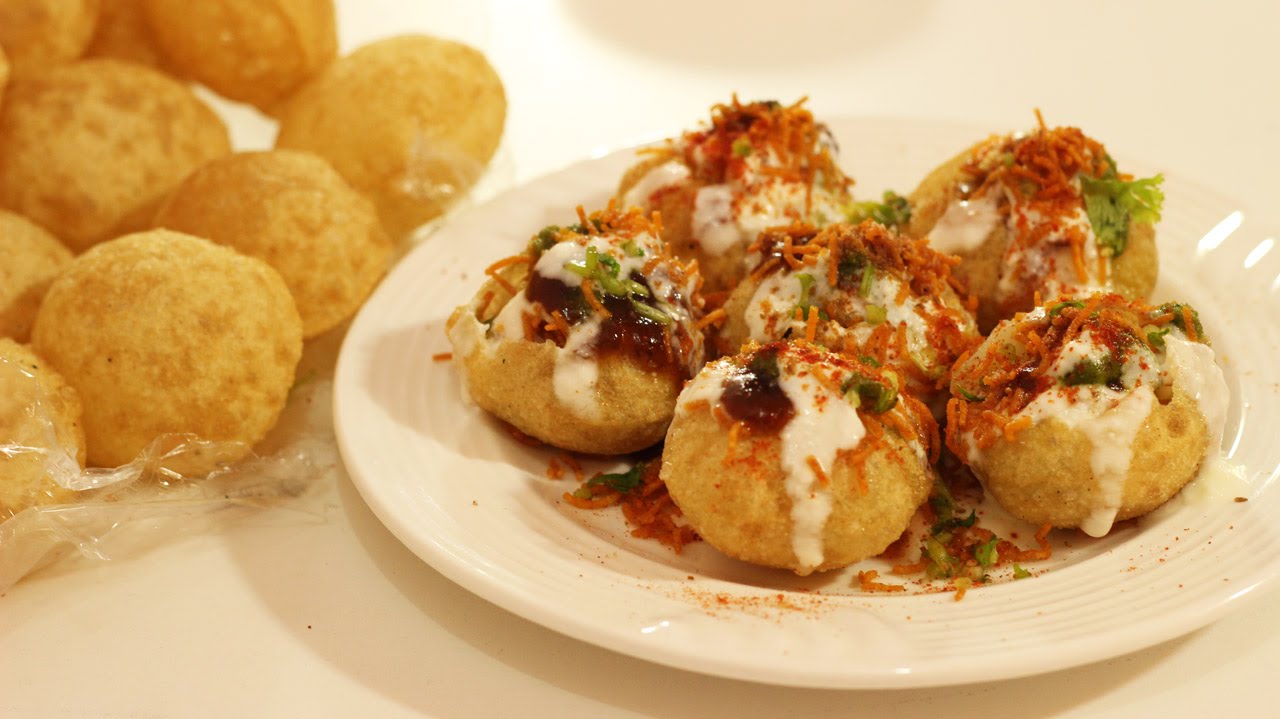
All dahi puri are created a little differently. These at Shri Balaji Bhavan come with plenty of tamarind chutney for those with a sweeter tooth.
Photo by Katharine Shilcutt

Dahi puri
 
These little snacks are one to two bites each (depending on how dainty of an eater you are) and packed with flavor. This is perhaps the most "advanced" item on this easygoing beginner's list, solely because of the blend of flavors and ingredients found in each puffy puri shell. But it's also my favorite. It's not just about the brightly bouncing flavors inside shells -- sour-sweet tamarind chutney, tangy yogurt, spicy mint chutney, stiff red onions, herbal cilantro -- but about the contrasting textures and even temperatures. The chickpeas inside are soft and tender under the boisterous crunch of the puri shells and shreds of sev, the yogurt cold and bracing against the warmer chutneys.

Gulab jamun and kheer

 
What's a meal without dessert? Think of gulab jamun as Indian donut holes, where the little balls of dough are fried and then coated with a glaze of simple syrup laced with rosewater. The dough soaks up that sweet, sugary syrup, which oozes out as you take a bite. And kheer is simply the rice pudding that is featured as a dessert across dozens of different cuisines. Here, it's jazzed up with a variety of ingredients: You'll find it plain, or topped with items such as pistachios, raisins, cardamom pods and more.
Mango lassi
Think about the best mango smoothie you ever had. This is better.


Kamis, 21 Januari 2016


COOKING, R.I.P.?Cooking, R.I.P.?


It wasn't all that long ago that Havas PR's annual trends report barely touched on the topic of food. Our trends for 2010 included a forecast of "increased interest in mastering skills that were previously outsourced," such as "fixing the plumbing, putting up shelves and growing vegetables," and that's it. Food hadn't taken over everyone's lives like it does today.
And yet ... in our agency's "11 Trends for 2016" report, we are already predicting the death of cooking.
No matter the lifetime's worth of ideas and inspirations from food channels, TV shows, cookbooks, magazines, websites and blogs, says the report, "assembling is the choice for people who want to feel involved in preparing the food but are happy to pay a company to do a lot of the work." For rather than an army of would-be Julia Childs over their stoves--and although people are eating at home more and eating out less--Americans in particular are watching other people cook for entertainment instead of doing it themselves. Traditional cooking, in the sense of making things from scratch (and cleaning it up), is on its way out. As Time editor Bill Saporito put it, "The reason my wife and I don't cook our food is the same reason that we don't hunt our food. These skills are no longer required to sidestep starvation." A growing proportion of kitchen activity involves warming up ready-to-eat meals and precooked ingredients, and the market for them will keep rising.
Uneasy Street The report also brings to the fore an übertrend: Life now is defined by a sense of unease, if not outright fear, that things aren't as they should be, that threats are looming and that people need to do something about it. Emotional alarm bells are endlessly ringing. Here's the constant question we'll be facing more in the coming year: What's the easiest or most enjoyable way to make my present and my future more secure? In the area of food, that's evident in the continued rise of food orthodoxies: going vegan (or eating insects) to help the environment, going paleo because we don't think we should eat anything our caveman ancestors didn't, going gluten-free because we're afraid "frankenwheat" is toxic.
On a related note, it used to be that if restaurants or food packagers said their food was gluten-free or paleo or whatever, then we assumed it was. But now, thanks to a fearful and distrustful culture, and the ever increasing shunning of grain, a new portable device called Nima has been invented. Nima senses gluten in liquid or solid foods in about two minutes--no more relying on anyone else to inform us.
And speaking of uneasiness, it's no wonder parents have gotten so protective. But a backlash against helicopter parenting is brewing. There's increasing concern that kids who are shielded from all risks are more vulnerable as adults. And parents are getting nostalgic for their (maybe imagined) own carefree childhoods. Of course, everyone wants his or her children to be healthy, and the rise in kids' food allergies is a very real thing, but look for an awareness that when parents strictly impose their food dogma on children, those children might grow into teenagers who rebel by overdoing it on junk food. And a realization that gluten-free, vegan birthday parties just aren't as much fun.
Livin' Large No More? We've also been noticing that many of the smartest people in the world's great cities are cashing in and moving on, and the next generation is bypassing them altogether. Employers and talented workers are looking to second- and third-tier cities, often drawn by the intellectual pull of regional universities. Chefs are no exception, and many of the most talented will continue to search out new venues and look toward smaller cities like Charleston, S.C., and Portland, Ore.--perpetual winners on "best food cities" lists--where costs of living are lower but the populations are sophisticated enough to get what the top chefs are offering.

Minggu, 17 Januari 2016

GUIDE TO HUNGARY'S SIGNATURE DISHES.


 Not one but three types of sponge cake go into this luscious dessert. Fresh whipped cream, chocolate sauce and pungent rum bring the three layers of vanilla, chocolate and walnut together to form an exquisite dessert.


 Seven layers -- yes, seven -- of moist sponge cake sandwiched with chocolate buttercream. Plus, a thin layer of caramel on top to give it a lovely crunch.


Dieting in Hungary is not recommended.
The country's cuisine is a rich blend of Europe, Middle-eastern and Asian food. The French lend their influence with goose liver pate, while the seven-layer Dobos cake can rival Austria's famed Sachertorte for sickly sweet extravagance.
Food here is abundant and affordable -- a nightmare for weight-watchers, a dream for true foodies.

Goulash
 Is it a soup? Is it a stew? Hungary's national dish is a cross between the two. It's hard to find a restaurant that doesn't serve it -- from the humblest café to the grandest establishments.
Goulash -- is it a soup? Is it a stew?
Hungary's national dish (pronounced "gooyash," by the way) is a cross between the two, a steaming bowl of slow-cooked beef, carrots, onions and loads of Hungary's trademark paprika to give it a good kick.
It's hard to find a restaurant that doesn't serve it -- from the humblest café to the grandest establishments.
Where to try it: In the sleek, modern surroundings of Budapest Bisztro (Vecsey utca 3, +36 1 783 0788).

Langos
 It's simple: A deep-fried flatbread topped with sour cream and grated cheese -- sometimes with a bit of garlic just to annoy the person next to you. The Danube town of Szentendre has some of the best langos in the country.
The Hungarians' favorite street food certainly hits the spot on a chilly morning when you're desperate for a quick bite before lunch.
It's simple: a deep-fried flatbread topped with sour cream and grated cheese -- sometimes with a bit of garlic just to annoy the person next to you.
Where to try it: The Danube town of Szentendre has some of the best langos in the country. There's tiny alleyway leading to St Janos church in the main square, where a sign helpfully saying "langos" should point you in the direction of a nameless stall halfway up the alley.

Paprika chicken
Those sweet red peppers that are such a staple of Hungarian cooking really shine in this popular stew also known as chicken paprikash.
Made to make your mouth water.
Powdered paprika goes into the dish too, along with onions, garlic, tomatoes and a dollop of sour cream.
Served with egg dumplings called nokedli (like the Austrian spätzle), it's comfort food that's hard to beat.
Where to try it: If you're in the Buda Castle district of Budapest, try Alabardos Restaurant (Orszaghaz utca 2, +36 1 356 0851).

Hortobagyi meat pancakes
 Hungarians adore their palacsinta -- pancakes that are more like French crêpes. This savory version is a rich stew of minced veal or chicken tucked inside the pancakes and smothered with a sour cream and paprika sauce.
Hungarians adore their palacsinta -- pancakes that are more like French crêpes than the thicker American ones you douse with maple syrup.
This savory version is just as decadent: a rich stew of minced veal or chicken tucked inside the pancakes and smothered with a sour cream and paprika sauce.
Where to try it: While relaxing under the stone arched ceiling of Pierrot (Fortuna utca 14, Budapest, +36 1 375 6971), housed in a 13th-century former bakery.

Goose liver pâté
 Hungarians are right behind the French in their love for this buttery delicacy. Goose liver pate is best served wrapped in bacon and lightly grilled.
It's not just the French who like goose liver; the Hungarians are right behind them in their love for this buttery delicacy.
Where to try it: They wrap it in bacon and lightly grill it at Aranysarkany Vendeglo restaurant in Szentendre (Alkotmany utca 1; +36 26 301 479). Or you can have it as a starter at one of Budapest's landmark restaurants, Gundel (Gundel Karoly Way 4, +36 1 468 4040), in the lush surroundings of the city park.

Cold sour cherry soup
While a lot of Hungarian dishes are perfect for cold days, chilled sour cherry soup is just the thing for warm summer evenings. Fresh sour cherries combine with sour cream and sugar in this refreshing classic.
More refreshing than it looks -- promise.
Where to try it: Leves (Vamhaz korut 14, Budapest, +36 30 241 7760), for the takeout version.

Tihanyi pike perch
 Everyone flocks to Lake Balaton to feast on the lake's plump pike perch. Gorgeous views of the lake come with delicious plates of fish that you can have roasted, grilled or prepared Tihanyi style.
Lake Balaton is Hungary's playground, where everyone flocks to laze in thermal springs and feast on the lake's plump pike perch.
You can have this succulent fish roasted, grilled or prepared Tihanyi style: made into a terrine with cream, white wine, spinach and dill.
Where to try it: Gorgeous views of the lake come with delicious plates of fish at Ferenc Pince Csarda (Cserhegy 9, Tihany, +36 76 448 575) from its prime position on the Tihany peninsula. 

Stuffed cabbage leaves
 Here they're called toltott kaposzta. They're parcels made up of pork mince stuffed into cabbage leaves with -- you guessed it -- lots of paprika.
You won't go far in Central and Eastern Europe without coming across cabbage rolls, and Hungary is no exception. Here they're called toltott kaposzta: pork mince stuffed into cabbage leaves with -- you guessed it -- lots of paprika.
It's best with sour cream on top, in true Hungarian style, along with sauerkraut and chunks of smoked pork.
Where to try it: After browsing the stalls in Budapest's Central Market, you can grab a plate of hearty stuffed cabbage upstairs in Fakanal Etterem (Vamhaz korut 1-3, +36 1 217 7860).

Kurtoskalacs (chimney cake)
"Chimney cake" is made by wrapping pastry around a cylinder to bake over the last of the embers in an open fire. The pastry is also often coated in lots of sugar so the lovely sticky caramel coating can hold on to the extra flavors dusted on top -- anything from cinnamon to cocoa to chopped walnuts.
Best before ... you help yourself to another.
Where to try it: It's best slightly warm with ice cream and coffee in Molnar's Kurtoskalacs café (Vaci utca 31) in Budapest.

Dobos cake
 Seven layers -- yes, seven -- of moist sponge cake sandwiched with chocolate buttercream. Plus, a thin layer of caramel on top to give it a lovely crunch.
Seven layers -- yes, seven -- of moist sponge cake sandwiched with chocolate buttercream. Then, before things get too gooey, there's a thin layer of caramel on top to give it a lovely crunch.
We have 19th-century Hungarian confectioner Jozsef Dobos to thank for this heavenly creation which has become a staple in Hungarian coffeehouses.
Where to try it: The sumptuous interior of Budapest's Central Kavehaz (Karolyi Mihaly utca 9, +36 1 266 2110) is a suitably grand setting for such a glorious cake.

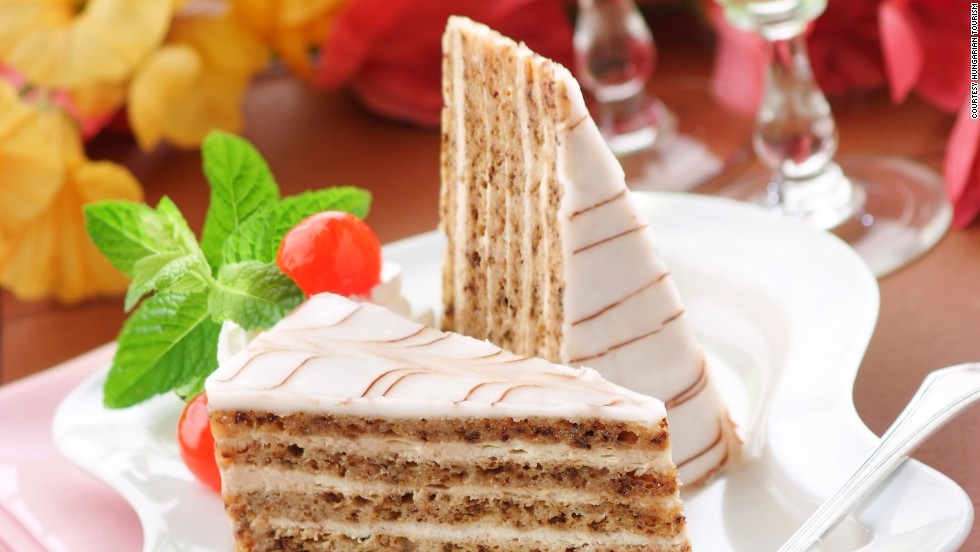
Eszterhazy torte
 The Hungarian royal's name, Prince Eszterhazy, lives on in one of Europe's most famous cakes: Five layers of almond meringue and buttercream with elegant swirls on top.
A cake fit for a prince -- Prince Eszterhazy, to be precise.
The Hungarian royal's name lives on in one of Europe's most famous cakes: Five layers of almond meringue and buttercream with elegant swirls on top.
Where to try it: Just around the corner from Budapest's ornate Parliament is Szalai (Balassi Balint utca 4, +36 1 269 3210), a delightfully old-fashioned cake shop where you can indulge in one of these royal treats.

Somloi sponge cake
 Not one but three types of sponge cake go into this luscious dessert. Fresh whipped cream, chocolate sauce and pungent rum bring the three layers of vanilla, chocolate and walnut together to form an exquisite dessert.
Not one but three types of sponge cake -- vanilla, chocolate and walnut -- go into this luscious dessert.
But it doesn't stop there: Fresh whipped cream, chocolate sauce and pungent rum bring the three cakes together to form an exquisite dessert. 
 Where to try it: For sheer opulence, this rich dish is best devoured in the fantastic interior of the New York Café (Erzsebet korut 9-11, +36 1 886 6111) in the Boscolo Budapest hotel.