Tampilkan postingan dengan label GERMANY. Tampilkan semua postingan

Jumat, 29 Januari 2016

GRENADE THROWN AT ASYLUM HOSTEL IN GERMANY.

 
Police vehicles outside a migrant shelter that was targeted with a grenade


Unidentified attackers threw a live hand grenade at a migrant hostel in south-western Germany, officials say.
The grenade was found during the night near buildings housing 170 people in the town of Villingen-Schwenningen. Its pin had been pulled out but the explosives failed to detonate.
Justice Minister Heiko Maas said it was a new level of "hate and violence".
There were 1,005 attacks on refugee homes in Germany last year - five times more than in 2014.
Some of the migrants at the Villingen-Schwenningen hostel were evacuated while bomb disposal experts carried out a controlled explosion.
Police spokesman Thomas Kalmbach said it was "just luck" no-one was hurt.

 Police outside the migrant shelter that was targeted with a grenade

 Map of Villingen-Schwenningen


Officers said the grenade still contained its explosives but it was not clear whether it still had a detonator.
Mr Maas said he was summoning his regional state counterparts to crack down on hate crime.
"Grenades are already flying towards refugee homes. We can't wait until there is someone dead," he said.

Spike in attacks

News of the grenade incident came as new figures showed five times more attacks were carried out on migrant hostels in Germany last year than in 2014.
The total for 2015 was 1,005, compared with 199 in 2014, the police report said. Far-right activists are suspected in 90% of the cases.
Last year a record 1.1 million people sought asylum in Germany - many from war-torn Syria. Many local authorities have struggled to house them.
Germany is expanding its list of safe countries of return, hoping to curb the influx.
The governing coalition plans to declare Morocco, Algeria and Tunisia safe countries of origin, making it easier to send migrants back, said Vice-Chancellor Sigmar Gabriel.

 Migrant arrivals in 2015 - map


Last year Germany did the same for several Balkan nations - including Albania, Bosnia-Herzegovina and Kosovo - to cut the large numbers of migrants claiming asylum. Very few of their applications are granted.
The police say the biggest rise in attacks on migrant hostels last year was registered in the mainly industrial state of North Rhine-Westphalia.
State Interior Minister Ralf Jaeger said "investigators have noticed a marked increase in aggressive language" towards migrants on the internet.
Most of the thousands of migrants arriving daily on Greek islands hope to get asylum in Germany.

Where Europe is failing on migrants

  • The 28 member states have not agreed on an EU-wide mechanism for relocating migrants, to ease the burden on Greece and Italy; only small groups have been relocated so far - and several states in Central and Eastern Europe refuse to accept migrants
  • The Schengen agreement on freedom of movement is in jeopardy - Hungary fenced off its borders with Serbia, Croatia and Slovenia; meanwhile Germany, Austria, Denmark, Sweden, Norway and France have also reimposed border controls
  • The Dublin regulation, under which refugees are required to claim asylum in the member state in which they first arrive, is not working effectively; countries are no longer sending back migrants to their first point of entry to the EU
  • Thousands of migrants - many of them Syrian war refugees - still arrive daily from Turkey
  • Processing of asylum applications is slow and there is a big backlog - so reception centres are overcrowded
  • Germany - the main destination for migrants - is rethinking its open-door policy, partly because of outrage over assaults on women in Cologne at New Year


Kamis, 28 Januari 2016

GERMANS MUST BAN ALCOHOL IF THEY WANT TO PREVENT FURTHER SEX ATTACKS AND HELP NORTH AFRICANS INTEGRATE, SAYS MUSLIM GROUP.


Germany needs to ban alcohol if it wants to prevent further sexual violence and to help North African migrants integrate into society, a Muslim pressure group has claimed.
Commenting on the Cologne sex-attack controversy, MuslimStern, which has 20,000 followers on Facebook, said its mission was to 'highlight the way the media was using the incidents to promote racism against minorities'.
The group complained that the female victims had brought the unwanted attention to themselves by dressing in a manner that North African men were not accustomed to. 
Large groups of Muslim men who congregated around the cathedral in Cologne on New Year's Eve are believed to be responsible for more than 520 sexual assaults and at least three rapes on women in the city
The MuslimStern Facebook page has called on German authorities to ban alcohol claiming that Cologne women were responsible for their own attacks by comparing them to a naked antelope thrown in front of a lion
The group claimed: 'The government should ban the consumption of alcohol because it leads to traffic accidents, violence and rapes, and is extremely damaging to health. But for capitalist societies, this is too much to expect. So long as alcohol is not prohibited there will be no discernible decline in these cases'
The group claimed: 'You cannot expect to chuck a naked antelope in front of a lion and not expect it to react. It is mind boggling that with so much time spent teaching children about sex at school, they completely forget to pass on this basic biological fact.' 
As a consequence of the attacks, they urged the German government to introduce a ban across the country on the consumption of alcohol. 
The group also blamed women for getting attacked by inciting the young men.

In one section of the Facebook post, which has since been deleted, the group claims: 'Some women should think about whether it is wise to lightly dressed and drunk, to go between hordes of drunken men. 
'In general, the woman wearing due to their nature have a responsibility when it goes out of the house. 
'You can not throw a naked antelope from a lion and expect that at the lion stirs nothing. 
'It is amazing that is taught in biology class so much about the mating and sexual behavior of living things, but these rules are completely ignored in everyday life. 
'And because many non-Muslims constantly emphasise that we live in a Christian country, we call on you, in this country that women should dress Christian. 
'Mary, Mother of Jesus, lived out as a Christian woman has to dress. So it would be highly recommended for some women to take Mary as a role model and not Lady Gaga.' 
Searching for a home: Refugees   walk along a street as they cross the Slovenian-Austrian border today
Searching for a home: Refugees walk along a street as they cross the Slovenian-Austrian border today
More than 520 women have reported assaults from New Year's Eve with at least three rapes which have been blamed on Muslim migrants who congregated around Cologne's cathedral during the night.
Cologne's Muslim preacher Imam Sami Abu-Yusuf, who blamed women wearing perfume for the fact they were assaulted over the New Year, went on to justify it by saying that alcohol had taken away the restrictions of 'men from North Africa'.
He also added that the sex attackers were 'from North Africa', unlike Salafists like himself who are mostly from India and the Middle East. 
Mr Yusuf had earlier told Russian TV women only had themselves to blame for being assaulted because of the way they dressed. When asked why the attacks had happened he told REN TV: 'One of the reasons is the way the women were dressed. If they just wear light clothing and put on perfume, then things like this will happen.'
After the comments local Green MP Volker Beck complained to police about the comments saying it was incitement to carry out crime.
As the controversy raged over the remarks, a reporter from the Cologne Express asked him to qualify his statements, and reported that he laughed when asked if he really believed that women were responsible for the attacks they suffered.
He told the Express: 'My reply was taken out of context. What I said was that we have a real problem with men from North Africa living in Cologne. These young men take tablets and drugs, and over New Year they took alcohol which took away all the barriers.'

Cologne Imam Sami Abu-Yusuf, pictured, suggested the women were attacked because they 'wore perfume'

The number of sexual assaults has prompted numerous demonstrations in Germany and caused significant political problems for chancellor Angela Merkel who is seeking to resolve the issue of uncontrolled migration

Cologne police were heavily criticised for their failure to protect women from the men who had gathered

Asked if that was the reason he was saying the women were attacked, he said: 'No, that is of course forbidden and not only for Muslims. But there were women with very open clothing and they were wearing perfume, and at the same time while walking through the drunken masses, of course for these North African men, that was an excuse to grope them. That doesn't mean to say that I believe women cannot be dressed like this. Everyone has to accept that.'
However as the controversy grows, German security experts have admitted that they had the mosque where he preaches under surveillance for more than a decade, including a raid in 2004 over suspicions that it was at the heart of a secret network of Arabic mujahedeen.
However they failed to come up with any concrete evidence of terrorist attacks that were planned. It has also been confirmed that he is regarded as Salafist extremist orientated on Wahhabism, which is the stricter Saudi Arabian form of Islam.
German FDP-Politician Tobias said: 'His statements are typical thinking for a Salafist. Not just he but other Salafists and Salafists on online platforms have justified the rape of women in the same way.' 
MuslimStern has criticised the way refugees from North Africa and the middle east have been treated 

Selasa, 26 Januari 2016

GERMAN PLAN SHELTERS FOR GAY REFUGEES AMID ATTACKS

Image: Gay refugees in Germany
Gay Syrian refugee partners and Auz at the Berlin headquarters of the LSVD, the German Lesbian and Gay Association. Sean Gallup
MAINZ, Germany - Support groups in Germany are planning special shelters for gay refugees and migrants after incidents of abuse and violence amid the country's record-setting immigration.
The Lesbian and Gay Federation in Germany (LSVD) says several incidents of discrimination and physical assaults against gay refugees have been reported in the past year.

 Berlin officials identified 95 cases in the German capital alone between August and December 2015, mainly in refugee homes," Markus Ulrich from the LSVD told NBC News.
It comes as Germany grapples with an unabated refugee influx, with several thousand migrants arriving every day. Many have fled countries such as Iraq and Syria where ISIS militants are targeting or killing homosexuals.
In Austria, a special guide informs incoming migrants about equal rights for gay people. Republic of Austria
Now LGBT communities in Berlin, Nuremberg and other major cities are now planning to set up special shelters exclusively for gay and lesbian refugees.
"We have been alerted to a growing number of insults and violent acts against queer refugees, including cases of rape," Marcel de Groot, manager of Berlin's gay counselling centre, Schwulenberatung, told NBC News.
The support organization estimates that "between 5 and 10 percent of the 70,000 refugees that arrived in Berlin last year were gay, lesbian or transsexual," he added.
Schwulenberatung has had to find emergency accommodation for up to 70 people, mostly gay men, in private Berlin homes because "they had strong fears in the refugee shelters or became victims of attacks," de Groot said.
Social workers and volunteers believe that the estimated number of unreported cases could be even higher. "Many homosexual refugees do not trust police," said de Groot, because authorities in their home counties "often persecute them for their sexual orientation."
"We need to act quickly" to support homosexuals among the large group of refugees, Ulrich added.
Gay-rights organizations are also hoping to set up a nationwide support network for refugees in Germany. Even before identifying exclusive shelters for LGBT migrants, organizations launched weekly meetings for homosexual and transsexual refugees and set up websites such as "Queer Refugees Welcome," which provides information about the asylum process in languages including English, Arabic, Dari and Farsi.
Meanwhile, the Austrian Interior Ministry produced a "refugee guide" aimed at providing some basic guidelines and regulations for arriving refugees, including a cartoon explaining that "same-sex partnerships are allowed in Austria. Women may live together with women and men with men."

Senin, 25 Januari 2016

THESE EUROPEAN COUNTRIES ARE SEIZING CASH AND VALUABLES FROM REFUGEES.

Migrants from Syria arrive at the railway station in the Swiss town of Buchs, Sept. 1, 2015.
Reuters
KYIV, Ukraine — Refugees fleeing the Middle East and other troubled regions already face daunting challenges when they reach the European Union. But if they choose to stay in Switzerland, Denmark, or Germany, that decision could cost them even more.
Critics have been up in arms lately against regulations that allow officials in those countries to confiscate assets from asylum-seekers to help finance their stay.
The cut-off for when authorities start taking cash and valuables varies from country to country, ranging from $400 to $1,500. It’s one of many measures European officials have taken in recent months to help cope with the continent’s largest migration crisis since World War II.
They also include temporary border controls in the passport-free Schengen zone, which a group of six leading countries may vote to extend at a meeting in Amsterdam on Monday.
Unlike Switzerland or Germany, Denmark has yet to pass its own legislation (it’s expected to soon). But it’s already taken flak from the UN Refugee Agency, which calls the proposal a “deeply concerning response to humanitarian needs.”
Critics have also spoken out over social media. Twitter accounts such as @SaveSwitzerland and @SaveDenmark have popped up, poking fun at what they believe is the hypocrisy of two wealthy European nations that shouldn’t have problems covering the costs of asylum-seekers.
The regulations are reportedly being applied in southern Germany, too, where the vast majority of the country’s refugees enter. But officials there, as well as in Switzerland and Denmark, are defending what they say is a standard federal law with a reasonable foundation —  — and one that actually promotes equality.
“If you apply for asylum here, you must use up your income and wealth before receiving aid,” Germany’s immigration commissioner, Aydan Ă–zoguz, told a local tabloid this week.
“That includes, for example, family jewelry,” she added. “Even if some prejudices persist, you don’t have it any better as an asylum seeker as someone on unemployment benefit.”
Meanwhile, Denmark’s ruling Liberal Party has called the proposed Danish measure the “most misunderstood piece of legislation” in the country’s history. Officials there are stressing that authorities won’t be confiscating sentimental items, such as wedding rings, while the Swiss law allows refugees to reclaim their assets if they leave within seven months. According to the BBC, asset seizures in Switzerland took place in only 112 cases out of about 30,000 asylum applications last year.
All that may be so, but it’s unlikely the criticism will ease up any time soon.

Minggu, 17 Januari 2016

ANGRY POLITICIAN SENDS REFUGEES TO MERKEL.

 Angry politician sends refugees to Merkel


Berlin - An irate local politician from Germany's southern state of Bavaria took a bus carrying 31 refugees to Chancellor Angela Merkel's office in Berlin on Thursday as a protest against her open-door refugee policy.
The Syrians, escorted by police, arrived after a 550-kilometre trip outside Merkel's office, where a dozen German protesters, unconnected with them, were chanting “Merkel must go” in protest at her line on immigration.
Peter Dreier, head of the southeastern town of Landshut, acted on a threat he made to Merkel last year when he said his municipality could no longer cope with the number of arrivals.
“I think that we have to ensure the humane treatment of these refugees,” Dreier said upon his arrival in the capital, travelling on the bus with the refugees.
“On this scale and within such a short time we simply can't guarantee that any more.”
Authorities in Landshut had arranged for the refugees to be transferred into the hands of local authorities in Berlin. They did not get off the bus for an hour amid confusion over what accommodation had been arranged. Only asylum centres appeared to be available.
“I am a little disappointed since I've been in touch with the Chancellery and didn't expect the refugees to be sheltered at camps here in Berlin,” Dreier said.
German newspaper “Die Welt” reported that Dreier eventually decided to pay for the refugees' immediate accommodation at a hotel out of his own pocket.
Government spokesman Steffen Seibert issued a statement in response to Dreier, saying that accommodating the hundreds of thousands of migrants who have entered Germany in recent months was the responsibility of federal states and municipalities.
“The government is aware that the current number of refugees is posing significant challenges throughout Germany and especially in Bavaria,” Seibert said, adding that additional financial support was being provided to communities this year.
Dreier represents the Freie Waehler, a loose grouping of politicians who do not have a common policy, but campaign on individual issues.
Merkel is under increasing pressure to stem the flow of migrants coming to Germany.
About 1.1 million people arrived last year and several thousand continue to stream in every day and there has been a backlash by right-wing groups.
Mass sexual assaults on women in Cologne at New Year by gangs of young men described by police as being of Arab or North African in appearance, have deepened worries.
The frustration in Bavaria, the main entry point for most migrants, is especially strong with Merkel's conservative allies, the Christian Social Union (CSU), repeatedly calling on her to introduce a formal cap on migrant numbers.
She has resisted such a cap, arguing it would be impossible to enforce.


Sabtu, 16 Januari 2016

2 GERMAN TRANSGENDER WOMEN ARE STONED IN THE STREET.

Two German transgender women 'are STONED in the street' by a gang of three North African teenagers in Dortmund who said 'such people' should be killed


Three teenagers of North African origin have been arrested in connection to the alleged assault of two transgender women in the German city of Dortmund.
Named only by their first names as Yasmine and Elisa, the two victims said that they were verbally abused and threatened with stones by the men near the city's main train station last Monday.
The attackers allegedly said they were going to stone the two women before a police officer intervened.
Three men of North African origin are being sought in connection to the alleged assault of two transgender women in the German city of Dortmund
Elisa, 37, and Jasmin, 50, said that the men spoke to them in Arabic and said they needed to stone 'such people', according to the German media organisation Breitbart
'Within seconds we were tossed around…and they took stones from a gravel bed on the corner and threw them at us,' said one of the alleged victims.
The two women said that their attackers tried to grab their hair and breasts during the confrontation. 
One of the girls claimed that the men picked up a handful of gravel and tried to throw it directly at the two of them.
The suspects abandoned their attack on their victim and were arrested by a police officer.
One of the girls claimed that the men picked up a handful of gravel and tried to throw it directly at the two of them, near the central railway station
Speaking on the German broadcast channel Sat 1, one of the victims spoke of their disgust of the nature of the attack.
'This is barbaric what they have done, they were barbarians!' said Jasmine.
Following a police investigation, it was revealed that two of the teenagers are known to police for past offences.
The three North Africans have been put into custody, according to a police statement.


NEW EDITION OF HITLER'S 'MEIN KAMPF' SELLS OUT IN GERMANY.

Adolf Hitler's 'Mein Kampf' Sells Out After Week on German Bookshelves.


MAINZ, Germany — The first 4,000 copies of Adolf Hitler's "Mein Kampf" have sold out less a week after a new annotated version of the Nazi leader's manifesto hit German bookstores.
Publishers also received 15,000 pre-orders before sales even started on January 8, said Simone Paulmichl of Munich-based Institute of Contemporary History (IFZ), the government-funded research institution that produced the book.

"We were quite surprised that there were so many advance orders, despite the fact that people did not even have the chance to take a first look in bookstores," she said. IFZ did not say when the next print run would be.
The 2,000-page book, which is being sold for 59 euros ($64) across the country, has also reached the non-fiction bestseller list of Germany's prestigious news magazine Der Spiegel.
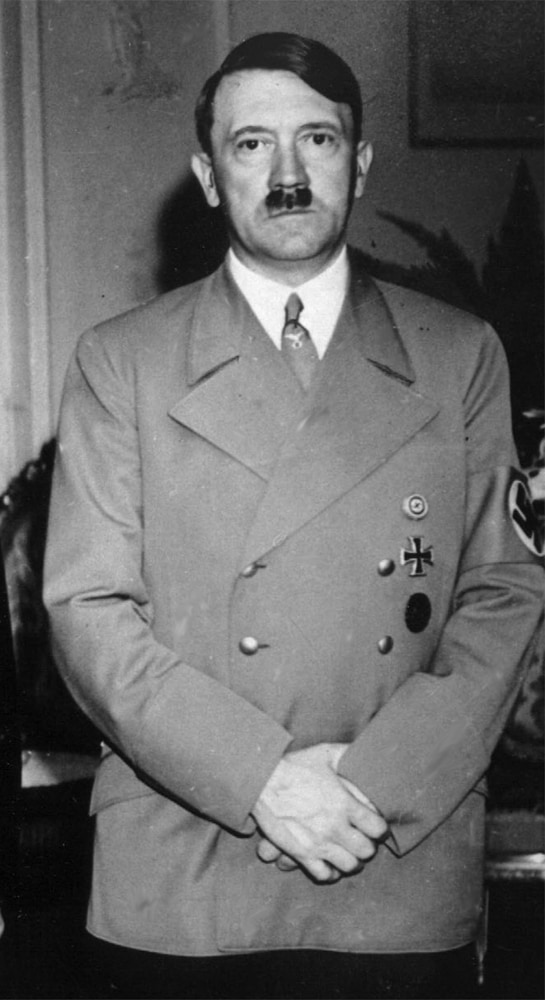
Image: Adolf Hitler in 1938
Adolf Hitler in 1938. AP file
This is the first time that "Mein Kampf" — which translates as "My Struggle" or "My Fight" — has gone on sale in Germany since World War II. But by the fall of Hitler's Nazi regime, more than 12 million copies of the book had been printed.
The southern German state of Bavaria, which had held the copyright since 1945 when it took over control of the main Nazi publishing house, blocked all reprints out of respect for the victims of the Holocaust. IFZ decided to publish the book after the copyright expired.
However, English-language editions of "Mein Kampf" are accessible online in full.
As opposed to the original, which was aimed a spreading the Nazi leader's thoughts, the new version of "Mein Kampf" strives to understand and put into context its hateful language and ideology, publishers said.
"Hitler's 800-page book is in great parts anti-Semitic, displays imperialistic thinking and violence," the IFZ's Christian Hartmann told NBC News ahead of the publication. "For Hitler, violence was the core of human existence."
Related: New German Biography Casts Hitler in Different Light
In an editorial entitled "A good new edition of a very bad old book," Britain's Guardian newspaper praised the "care, wisdom and admirable scholarship" with which the new edition had been put together, saying that the publication "goes one step further towards demystifying the roots of the evil that unfolded."
IFZ said buyers were mostly interested in contemporary history or were fans of non-fiction political books.
"The feedback from booksellers shows that it is not the ideologically problematic people, the neo-Nazi types, who buy the book," Paulmichl said.
Another sign of the book's popularity was that a panel discussion organized by the IFZ on Tuesday sold out — attracting 510 visitors.
"The scientific reviews and assessments following the publication were very positive," Paulmichl added.


Senin, 11 Januari 2016

 HUNDREDS OF SEXUAL ASSAULTS CHARGES FROM NYE, COLOGNE, GERMANY.


(CNN)The number of criminal charges from New Year's Eve attacks in the Cologne, Germany, has risen to 516 -- 40% of which relate to sexual assaults, police said.
The spate of sexual assaults and muggings prompted protests in Cologne over the weekend that at times turned violent.
Many of the protesters were angry at police response to the attacks as well as the influx of migrants and refugees into Europe.
"Where were you on New Year's Eve?" one protester yelled at police. "Why didn't you protect those women?"
Right-wing groups threw beer bottles, firecrackers and stones at officers in riot gear. Cologne police responded with tear gas and water cannons.
 

German Chancellor Angela Merkel has condemned the attacks in Germany as "disgusting, criminal acts." But she did not back down on her commitment to welcome refugees who obey German laws and pledge to integrate into German society.
Cologne Police Chief Wolfgang Albers was fired Friday amid criticism of his department's handling of the violence.
And German Justice Minister Heiko Maas was among many who expressed disapproval of Cologne Mayor Henriette Reker for advising women to keep "more than an arm's length" away from unknown men.
Reker later said the comments had been taken out of context.

Other attacks in Europe

Reports of other New Year's Eve attacks have emerged from elsewhere across Europe.
Police in Kalmar, Sweden, said Friday they had arrested two men described as refugees. The men, who have since been released on bail, are suspected in two of the 11 sexual harassment complaints received in the town on New Year's Eve, police spokesman Johan Bruun said.

Police are looking for 10 to 15 more suspects who allegedly encircled a group of women in Kalmar and groped them, Bruun told CNN.
In all, 16 females from ages 17 to 21 said they were molested, he said.
In Salzburg, an Austrian city on the German border, two men have been charged with sexually assaulting women on New Year's Eve and New Year's Day, police said in a statement.
A 23-year-old Syrian citizen was arrested in the city's Old Town section on New Year's Eve after sending fireworks in the direction of a 17-year-old student, police said. She was slightly injured in her abdomen. Further investigation revealed the suspect allegedly had sexually abused a 20-year-old from Bayern in the inner city before the fireworks incident, police said.


And in Zurich, Switzerland, six women told authorities they were "robbed from one side, (while) being groped ... on the other side" by groups of men, Zurich police said Friday.
And in Helsinki, Finland, police said they are investigating two possible criminal offenses related to New Year's Eve harassment centered around "a gathering of asylum-seekers."
Both the Zurich and Helsinki allegations became public well after the incidents took place.

Sabtu, 09 Januari 2016

 MERKEL BACKS NEW POWERS TO EXPEL MIGRANT CRIMINALS.


Cologne hits back: Merkel backs new powers to expel migrant criminals as anti-Islam protesters take to streets and police admit 'majority' of sex attackers were refugees

Police use pepper spray against supporters of anti-immigration right-wing movement Pegida

One of the large banners held at the demonstration read: 'Citizens stand up. Protect our children and future. We are the people'
"If the law does not suffice, then the law must be changed' she said, vowing action to protect not just German citizens, but innocent refugees too.
Outrage is growing in Germany over the revelations that hundreds of women ran a gauntlet of groping hands, lewd insults and robberies in mob violence last week in the western city. 
At least 379 cases of violence on New Year's Eve in Cologne have been filed, with asylum seekers and illegal immigrants making up the vast majority of suspects, police said today.
The police said around 40 per cent of those case related to sexual assault and they are mostly investigating 'people from North African countries'.
Around 100 investigators are now looking into whether charges can be brought against the suspects.
Cologne police chief Wolfgang Albers was suspended yesterday after his force came under fire for failing to prevent the shocking night of crime, despite heightened police presence on New Year's Eve.
Witnesses described terrifying scenes of women running the 'gauntlet' of groping hands, lewd insults and robberies in the mob violence.
 Around 1,700 protesters from the anti-Islam Pegida movement (pictured) were kept apart from 1,300 counter demonstrators as tension mounted on the streets of Cologne
Around 1,700 protesters from the anti-Islam Pegida movement (pictured) were kept apart from 1,300 counter demonstrators as tension mounted on the streets of Cologne
Police used water cannon and pepper spray in an attempt to disperse some of the more aggressive protester
Police drive back right-wing demonstrators with a water cannon in Cologne in the wake of the sexual assaults around Cologne's main station on New Year's Eve


Police search a right-wing demonstrator outside the main station in Cologne where more than 100 women were assaulted by mob of migrants on New Year's Eve
Police use water to control supporters of Pegida, Hogesa (Hooligans against Salafists) and other right-wing populist groups in Cologne

Police drive back protesters at a demonstration by the anti-Islam Pegida movement in Cologne

A firework explodes near police officers during a right-wing demonstration in Cologne

German federal police said they had identified 32 people who were suspected of playing a role in the violence, 22 of whom were in the process of seeking asylum in Germany.
Officers found a note on one of the arrested men containing Arabic-German translations for phrases including 'nice breasts', 'I'll kill you' and 'I want to have sex with you'. 
The majority of suspects identified by federal police are also migrants, adding fuel to criticism of Merkel's liberal migrant policy - which brought 1.1million new asylum seekers to Germany last year.
Around 1,700 protesters from the anti-Islam Pegida movement were kept apart from 1,300 counter demonstrators as tension mounted on the streets of Cologne. Police deployed water cannon and pepper spray in an attempt to disperse some of the more aggressive protesters.
Waving German flags and signs meaning 'Rapefugees not welcome', 'Germany survived war, plague and cholera, but Merkel?', hundreds of Pegida supporters shouted 'Merkel raus' (Merkel out).
In response, counter-protesters, separated by police, chanted 'Nazis raus' at the site, where earlier, some 500 protesters, mostly women, had held a noisy rally against sexist violence.


Banging pots and blowing whistles, demonstrators waved signs in German meaning 'No violence against women' and 'No means no! It's the law!' while others read: 'Protect our women and children.' 

A woman addressed the crowd, made up of more or less organised groups and supporters taking a stand against the Pegida's demo.
'These hooligans are not our allies in our fight against sexual violence,' she shouts out over the crowd.
Turning to the hundreds of riot police surrounding the protest as activists from both left and right pour out of the Hauptbahnhof main station, she adds 'Where were you on New Years Eve?'
'Cologne is no place for racism. We don't want them [Pegida] here,' says Lisa, 23.
Alexander, 18, said: 'The things that happened on New Years Eve were terrible, but you cant blame all refugees because of what some did. 
'We are a rich country and it is out duty to care for those who come here and search for help. If you go out late at night and someone is an asshole, left or right, German or other, something can happen.'


'We can't mix up sexism and racism', added a 29-year-old woman. 
On the other side of the station, in the square by the cathedral where it is now reported that more than 100 women were sexually assaulted and robbed, there are even more officers than protesters.
We are heading towards importing the lack of respect for women in Muslim nations to us. All Muslim men don't do this, but enough for us to have a problem
Thomas Traeder, right wing Alternativ fĂĽr Dutschland party
'We are heading towards importing the lack of respect for women in Muslim nations to us. All Muslim men don't do this, but enough for us to have a problem,' said Thomas Traeder of right-wing populist Alternativ fĂĽr Dutschland party.
There is no mistaking who supports who in the square outside the station.. They move in groups of three to ten towards where the Pegida demo is set to start.
'We are taking back out country!,' one young man dressed in all black, who has a shaved head and sunglasses on, despite the bright sun.
Chancellor Angela Merkel has confirmed her CDU party on Saturday had approved a proposal seeking stricter laws regulating asylum seekers.
Merkel said the proposal, which will be discussed with her coalition partners and would need parliamentary approval, would help Germany deport 'serial offenders' convicted of lesser crimes.
'This is in the interests of the citizens of Germany, but also in the interests of the great majority of the refugees who are here,' Merkel told party members in Mainz. 
However, she also reiterated her mantra on the refugee issue, insisting again 'we will manage it.'

Bonn University political scientist Tilman Mayer said he doesn't see the CDU proposal as either a change of course, nor one likely to dispel many Germans' concerns.
'This is just a building block in a chain of statements from the government and also the chancellor,' he said on Phoenix television.
Though Merkel has decried the assaults as 'repugnant criminal acts that... Germany will not accept,' they provide fodder for those who have opposed her open-door policy and refusal to set a cap on refugee numbers.


Jumat, 08 Januari 2016

MERKEL CONSIDERS TOUGHER MIGRANT LAWS.

Angela Merkel

Ms Merkel's "open door" policy had already attracted criticism from within her party before the Cologne attacks 


German Chancellor Angela Merkel has said she will consider changes in the law to make it easier to deport migrants who commit crimes after sex attacks on women in Cologne.
The attacks on New Year's Eve have shocked the country and sparked a debate about Germany's open-door policy on migrants.
The police's handling of the events has also been sharply criticised.
The head of the city police force has been suspended from his duties.
Victims described chaos as dozens of sexual assaults and robberies were carried out with little apparent response from the authorities.
Under current German laws, asylum seekers are only forcibly sent back if they have been sentenced to at least three years, and providing their lives are not at risk in their countries of origin.
Officials from Angela Merkel's conservative Christian Democrat party are expected to propose that migrants jailed for any length of time should face deportation.
"I think there are indications that changes must happen," Ms Merkel said.
"The interior minister and the justice minister are discussing just what we could improve," she added.
Police officers stand in front of the cathedral in Cologne, 08 January 2016.
Image caption Police have come under fire following the Cologne attacks
A shop assistant sets up a row of pepper spray in a showcase of a gunsmith's shop in Berlin 
Image caption Sales of pepper spray have reportedly risen
The identification of the attackers in Cologne as North African or Arab in appearance has caused alarm in Germany because of the influx of more than a million migrants and refugees in the past year.
Meanwhile German officials have warned that anti-immigrant groups have been trying to use the attacks to stir up hatred.
Similar attacks to those seen in Cologne were also reported in Hamburg and in Stuttgart.
The anti-immigration Pegida group has said it will hold a demonstration in Cologne on Saturday.
Police are expecting around 1,000 people to gather in front of the city's main train station, German media reports say.

Discomfort under the surface :German media reaction

Debating rules on deporting criminals is a distraction, writes Heribert Prantl in the Sueddeutsche Zeitung. The law already provides for the deportation of criminal refugees, he says - the problem is the mistakes made by the police on the night and their inability to enforce the law.
Writing in the Frankfurter Allgemeiner Zeitung, Christian Geyer largely agrees. Whether or not Syrians, Afghans and Iraqis with asylum seeker status were among the perpetrators changes nothing in the debate, he writes. The questions for the police and justice system remain the same.
And while Chancellor Merkel's asylum policies are controversial, she doesn't need the help of favourable police reports, he adds.
Chancellor Merkel's friendly face is gone, writes Philipp Wittrock in Der Spiegel. The chancellor recognised that the events in Cologne had the potential to sow mistrust, divide society, and damage her political standing.
Discomfort in her own party at her welcoming asylum seekers continues to bubble under the surface, he writes.
Women describe 'terrible' assaults
Cologne mayor's 'code of conduct' attacked
The search for answers
Federal authorities say they have identified 18 asylum-seekers among 31 suspects linked to the crimes committed.
The suspects include nine Algerians, eight Moroccans, four Syrians, five Iranians, two Germans and one each from Iraq, Serbia and the US.
The state interior minister of North Rhine-Westphalia, Ralf Jaeger said on Friday that he had suspended police chief Wolfgang Albers from his duties.
He has been accused of holding back information about the attacks, in particular about the origin of the suspects.
Media caption"Twenty or 30 men surrounded us and we couldn't even move anymore"
Separately to the federal investigation focusing on what happened at the station itself, Cologne police are investigating 21 people in connection with the sexual assaults. It is not known how many of these are asylum seekers.
The state police have recorded 170 complaints of crimes, 117 of which involve sexual assault. There were two allegations of rape.
Two men, aged 16 and 23 and apparently of North African origin, arrested overnight on Thursday in connection with the sex attacks, have been released without charge, according to German media.

More on this story

 
More Videos from the BBC
  • Sheila the sheep sheared after being lost for six years
  • Boy, eight, who was attacked by chimps to get lip reconstruction
  • Southsea promenade flood defence wall collapses into sea
  • Who were the men killed in Islamic State video?
  •  
    Elsewhere on BBC
     
    You Might Also Like

    Rough seas

    Beaten up by China for fishing in the 'wrong' place

    The first Chinese jedi?

    The Force Awakens is set to hit China

    'A close call'

    Volunteer firefighter recounts Waroona fire

    It's complicated

    Cambodian leader's love/hate relationship with Facebook

    One girl's battle

    Struggling for life in a city under siege and under fire

    No heroes

    Danish film A War throws grim light on the morality of conflict

    Novel technique

    Could you train yourself to read 200 books a year?

    Existential crisis

    Why India's wealthy Parsi community is vanishing
     
    From Around the Web
  • This Teenage Clerk is a Big Security Risk Bit9 + Carbon Black Blog
  • Stop the clot! Just 6 extra minutes to save cancer patients theleadsouthaustralia.com.au
  • Have you traveled to the five busiest airports in the world?… Plane Stories
  • Moving to Australia with a blind leap of faith NewsLeads
  • LIONEL MESSI: How The Most Expensive Athlete In The World… Business Insider