Tampilkan postingan dengan label JAPAN. Tampilkan semua postingan

Kamis, 28 Januari 2016

OBAMA'S ASIA ENGAGEMENT ARCHITECTURE : A FRAMEWORK ON WHICH TO BUILD.


Less than one month into 2016, Secretary of State John Kerry visited Laos, Cambodia, and China, U.S. President Barack Obama welcomed Australian Prime Minister Malcolm Turnbull to the White House, and Secretary Kerry and Secretary of Defense Ash Carter hosted their Philippine counterparts for a 2+2 ministerial meeting. The pace of top-level engagement with Asia-Pacific leaders will accelerate in February when President Obama hosts a landmark summit with all ten ASEAN leaders at Sunnylands.
Already scheduled to visit Japan in July for the G7 summit, Laos in September for the East Asia Summit, Vietnam before or after Laos, and China in September for the G20 summit, President Obama is set to blow by President George W. Bush’s record for the most visits by a U.S. president to countries in the region. In the first seven years of his presidency, Obama’s seven trips to Asia have been a major pillar of the “new normal” of U.S. engagement in Asia that Assistant Secretary of State for East Asia and Pacific Affairs Danny Russell often touts.
Presidential attention has contributed to substantial gains for the United States in Asia during the Obama administration – a successful conclusion to the Trans-Pacific Partnership negotiations, agreements for military access in Southeast Asia and Oceania, a historic climate agreement with China, and new guidelines to modernize the U.S.-Japan alliance, among others. These accomplishments leave a substantial legacy on which the next U.S. president can build even deeper ties with the region.
But a key, underappreciated element of the administration’s focus on Asia has been the construction of an intricate architecture for engagement with the region that was only beginning to take shape before 2009. These vehicles have been essential to the Obama administration’s progress in deepening ties throughout the region and will also help the next U.S. president to build on Obama’s success in Asia.
While a robust framework for engagement with Europe developed during the Cold War – regular NATO summits, G7/8 summits, innumerable NATO Ministerial Meetings – relatively few structures existed in the Asia-Pacific to force U.S. leaders to focus attention on Asia. As a result, for decades, when Presidents and cabinet officials looked at their commitments for the year, they saw a raft of transatlantic meetings and very few requirements to engage with Asia. This manifested itself in meager top-level travel to the region — Presidents Johnson, Nixon, Ford, Carter, Reagan, and H.W. Bush each made only two trips to Asia during their presidencies; Presidents Truman and Kennedy did not make any. And the travels of their Secretaries of State and other cabinet members followed a similar pattern.
The pace of presidential travel to Asia began to increase substantially under President Clinton, largely due to the establishment of APEC, which put a mark on the calendar for Clinton, George W. Bush, and Obama to travel to Asia, at least during years when an Asian country would chair APEC. But this still did not mean Clinton and Bush always had a reason to travel to Asia, as they failed to travel to the region when the APEC summit took place in the Americas (1997 and 2004) and Oceania (1999, 2007).
President Obama’s decision to join the East Asia Summit was, critically, a commitment for the President of the United States to visit an ASEAN country every year, for the first time creating the kind of structure for Presidential engagement with Asia that has existed with Europe (but also still doesn’t exist for the Middle East or Africa) for decades. As a result, in years in which APEC is not held in Asia, like 2016, the president will still travel to Southeast Asia to attend the East Asia Summit, which this year will make Obama the first U.S. President to visit Laos. President Obama’s decision to hold regular U.S.-ASEAN leaders summits on the sidelines of UN General Assembly meetings and elsewhere has also raised the bar for U.S.-ASEAN leaders-level engagement.
Obama’s secretaries of state and defense have also been busy created an architecture for regular engagement with Asia that goes far beyond ad hoc bilateral visits. Together, the Secretaries of State and Defense have expanded the use of “2+2” meetings at the cabinet level, which had previously typically only been done with Japan and Australia, to include such meetings with allies South Korea and the Philippines. Moreover, with Australia, rather than having deputy secretaries stand in at the annual 2+2 Australian-United States Ministerial consultations (AUSMIN), as took place under previous administrations, AUSMIN has been attended by the cabinet secretaries every year since 2009. Perhaps most importantly, the secretaries of state and treasury have joined forces for the annual U.S.-China Strategic and Economic Dialogue, now bringing together more U.S. officials for this meeting than any other event on the diplomatic calendar.
Secretaries of State Clinton and Kerry also created mechanisms for annual dialogues with the foreign ministers of Indonesia and Singapore. In 2010, Secretary of Defense Bob Gates effectively institutionalized multilateral cabinet-level defense engagement in Asia by joining the ASEAN Defense Ministers Meeting Plus process and subsequent Secretaries have regularly attending special 10+1 sessions with ASEAN defense ministers on the sidelines of the grouping’s 10-member ministerial retreats. This track record has raised the bar for the next secretaries of state and defense.
The State Department and Pentagon have also created a raft of mechanisms for engagement with Asia at the sub-cabinet level that did not previously exist. For instance, an annual U.S.-Philippines Bilateral Strategic Dialogue co-chaired by Assistant Secretaries of State and Defense, created in 2010, has guided the alliance to its strongest state in decades, culminating in the U.S.-Philippines Enhanced Defense Cooperation Agreement. Under the radar, forums such as an annual U.S.-Malaysia defense policy dialogue, created in 2009 at the Deputy Assistant Secretary level, have deepened U.S. ties with the region, in this case bringing U.S.-Malaysia defense cooperation out of the shadows and facilitating enhanced U.S. military access in Malaysia. Even the annual U.S.-Laos Comprehensive Bilateral Strategic Dialogue, raised to the level of the Assistant Secretary of State in 2009, is set to yield dividends this year during Laos’ ASEAN chairmanship, as this framework has enabled both sides to better understand one another and to build ties.
When the Obama administration touts its record on Asia, it naturally points to concrete accomplishments such agreements on trade, defense, and climate change. But a key, underappreciated aspect of its policy has been to rebalance the time commitments of the U.S. government’s most senior leaders and to create an architecture for engagement with Asia that will outlive this administration. When observers debate the Obama administration’s legacy on Asia, this much will be clear – the bar has been raised for the time and attention a U.S. president must pay to Asia.

WHY DID RUSSIAN NUCLEAR-CAPABLE BOMBERS CIRCUMNAVIGATE JAPAN?


On Tuesday, January 26, Japan’s Ministry of Defense revealed that the Japanese Air Self-Defense Force had scrambled jets in response to two Russian Tu-95MS “Bear” strategic bombers near its air space. According to a map released by the Japanese government, the two Russian bombers approached Japanese airspace from Russia’s Primorsky province, flying over the Sea of Japan, and eventually flew along the perimeter of Japan’s territorial airspace, encompassing the four main Japanese islands of Honshu, Kyushu, Shikoku, and Hokkaido, before returning to Russia.
clipular
Source: Japanese Ministry of Defense.
The incident isn’t the first incident involving Russian strategic bombers near Japanese airspace by any means. Moscow regularly conducts such activities and Japan scrambles fighters to ensure that its territorial airspace isn’t violated.
However, the Tu-95′s flight path in this instance—along the perimeter of Japan’s islands—appears more provocative than usual. Generally, Russian bombers fly long-distance runs. For instance, Russian Tu-95s have been known to fly the length of the Ryukyu Island chain before returning to Russian airspace. (I discussed one such incident here at The Diplomat in late 2013.) Last March, Japan intercepted and escorted a Tu-95 over the Korean Strait between South Korea and Kyushu.
In 2014, shortly following Russia’s annexation of Crimea and ensuing isolation from the West, including expulsion from the G8 within which Japan is a member, Russian Tu-95 bomber patrols picked up in intensity in the Asia-Pacific region. As General Herbert “Hawk” Carlisle, the commander of the U.S. Pacific Air Force, said at the time, the United States noticed that Russian bombers were coming out to airspace near California and, similar to Tuesday’s incident, circumnavigated Guam. Even though Russia claims these exercises are routine patrols, intended to keep its Tu-95 bombers airworthy—which, given problems with Russian military aviation, isn’t entirely an unbelievable reason—the bomber flybys have a geopolitical messaging purpose.
Consider also that in late 2015, as my colleague Prashanth Parameswaran reported, Japanese officials publicly noted their growing concern about provocations from Moscow.  Relations between Japan and Russia have declined since Moscow’s foray into Ukraine, despite Japanese Prime Minister Shinzo Abe’s initial bonhomie with Russian President Vladimir Putin after coming into office in late 2012.
The territorial dispute between Russia and Japan over the sovereignty of the Kuril Islands—a lingering problem since the end of the Second World War—appeared to initially be heading toward resolution, but stalled last year. In fact, Russia moved to directly provoke Japan by announcing its intention to construct military and civilian infrastructure on the Kurils. In 2014—again, following its invasion of Crimea and G8 expulsion—Russia staged military drills on the Kuril Islands. The two countries ended 2015 with an indefinite postponement of a Putin state visit to Japan over the issue of the Kuril Islands.
In the context of the overall state of Japan-Russia bilateral relations, Tuesday’s circumnavigation of Japan’s main islands can be seen as one more provocation in a string of several over the past years. Incidentally, the incident comes just days after Abe, in an interview with Japan’s Nikkei, said that he wanted to engage Russia again. Abe currently chairs the G7 and said he wanted “constructive engagement of Russia.” Japan’s foreign relations remain complicated in its neighborhood and Abe is less-than-enthusiastic about the prospect of Japan bearing out the consequences of the West’s decision to isolate Russia.
Interestingly, as Samuel Ramani recently noted in The Diplomat, Russia’s harsh response to North Korea’s recent nuclear test could presage some positive engagement between Moscow and Tokyo—both Japan and Russia had a place at the table in the long-stalled Six-Party Talks. Since its isolation from the West, Russia had chosen to engage North Korea, going as far as to invite Kim Jong-un to its commemoration of the 70th anniversary of the Second World War (an invitation Kim declined). In November 2015, a Russian military delegation visited Pyongyang as well.
Given Russia’s response to North Korea and Abe’s recent overture to Moscow, a warming of relations between the two countries may have been in the offing. However, given Russia’s decision to stage a highly provocative circumnavigation of Japan by nuclear bombers, it’s more likely than not that the cool bilateral climate that persisted through 2015 is here to stay.

RESTORES ZERO FIGHTER TAKES TO THE SKIES IN JAPAN.

            
A restored Zero fighter flies over Japan's Maritime Defence Force's Kanoya air base in southern Japan, on January 27, 2016 (AFP Photo/) More than 70 years after striking fear into the hearts of Allied pilots, a restored Zero fighter took to the skies in southern Japan on Wednesday.
Japan’s most famous World War II fighter aircraft was developed by Mitsubishi Heavy Industries and was noted for its technological advancement.
The legendary planes took part in the Japanese attack on Pearl Harbor while “kamikaze” suicide pilots crashed them into US ships in the later stages of the war.
The restored plane took off from a Japanese military base on the island of Kyushu for two short flights, the Nikkan Sports newspaper reported.
The aircraft, painted dark green with round bright red “circle of the sun” symbols on its body and wings, was airborne for six minutes and 16 minutes, respectively, the report said.
The plane was found in 1970 in Papua New Guinea — the scene of fierce fighting during World War II — and restored, ending up in the United States before being brought to Japan in parts in 2014, the report said.
Other restored fighters have been flown over the country, but the Chunichi Shimbun daily reported that the flight Wednesday marked the first time since the end of the war that a Japanese-owned Zero took to the skies in Japan.

MCDONALD'S JAPAN'S NEW DOUBLE-CHOCOLATE FRIES.

 McDonald's Chocolate French Fries Don't Taste Disgusting

Salty potato fries covered in two types of chocolate sauce? We’re lovin’ it!

Ever since we first heard the announcement that McDonald’s Japan would be adding chocolate sauce to their sinfully salty, delicious fries, we’d been trying hard to imagine what the sweet-savoury carbohydrate combination could possibly taste like. Would it be a big hot mess of sickly sweet potato pieces? Or would it be a perfectly balanced indulgence that we would happily go back for again and again? We stopped by our local outlet as soon as they were released today to find out.
DSC00019
After looking forward to the new addition to their menu for almost a week, when we arrived at the fast food restaurant we were expecting huge banners and displays celebrating the release of the McChocolate Potatoes. Surprisingly, there was only one wall poster. We had to look hard on the menu to find them too; they were tucked away in a small spot at the top, under number 2.
DSC09948
The “Makku Choco Poteto”, as it’s called in Japanese, comes in two parts, with the sauce and fries (aka “McFry Potato”) served separately. It also comes with a fork, to avoid getting sauce all over your fingers.
DSC09981
DSC09991
▼ The fries come in a box that’s been specially designed for the limited-edition promotion.
DSC09968
The “double choco sauce” pack contains both white and plain chocolate. To use, simply squeeze the sides back with one hand, which will press  the bags of chocolate together, creating a beautiful simultaneous flow of both sauces. DSC09983
DSC09986
▼ Time to dress up those plain-looking chips!
DSC09994
The pretty swirls of white and plain chocolate made these look absolutely delicious!
DSC00043
DSC00046
On top of the fries, the white chocolate looked similar to mayonnaise. The heat of the chips, however, brought out the chocolate fragrance so there was no mistaking that we were about to tuck into a sweet serving of potatoes.
DSC00005
▼ We made an attempt with the plastic fork, but decided to enjoy them with our fingers instead.
DSC00012
We weren’t sure what to expect, but as soon as we tried them, we were hooked. The fluffy texture of the potato under its crispy skin went well with the soft, smooth sauce, giving a great balance to every mouthful. While we couldn’t make any distinction between the white and plain chocolate, the sauce tasted similar to the icing used on doughnuts.
DSC00070
If you close your eyes while eating them, the warm potato and chocolate sauce combination tastes a little like eating a freshly made doughnut. The closest thing we could liken it to would be baked dough and chocolate, only with a lightly salted potato thrown into the mix instead.
DSC00083
Without a doubt, the sauce was the prominent flavour, but with the savoury note, it didn’t taste like a dessert. Whatever the case, we couldn’t stop putting fistfuls into our mouths, so it was definitely a winning combination!

If you’d like to try the chocolate fries, they’re currently available at McDonald’s outlets all around Japan until mid-February, costing 330 yen (US$2.75). The McChocolate Potatoes can also be ordered instead of regular fries as part of a value meal for an extra 60 yen. They’re sweet, salty, delicious, and available only for a limited time so be sure to try them while you can!
DSC00007


Rabu, 27 Januari 2016

YAHOO JAPAN DEFENDS ONLINE IVORY TRADE.

Petition signed by over 1 million people calls on company to halt ‘appalling’ trade estimated at 12 tonnes in recent years


Yahoo Japan has defended its online trade in ivory amid mounting pressure calling on the company to stop selling thousands of products on its auction site.
The company sold an estimated 12 tonnes of elephant tusks and fashioned pieces of ivory on its Japanese auction site between 2012 and 2014, prompting the activist network Avaaz to launch a petition that has attracted more than 1m signatures.
Referring to the trade as Yahoo’s “bloody secret”, the petition calls on the chief executive of the company, Marissa Mayer, and Japanese head, Manabu Miyasaka, to “urgently stop all ivory sales from sites/platforms in Japan and all other markets”.


“As global citizens, we are appalled that you allow ivory to be sold … fuelling elephant extinction,” the petition says.
On Wednesday, the company defended the practice, insisting that it prohibited the sale of raw ivory and ivory products that violates a 1989 trade ban.
The firm said its auction site permitted only the sale of items that were produced before the ban went into effect. “Since there is a chance some sales may be illegal we are strengthening our policies. If we find a sale was illegal we cancel it straight away,” Takako Kaminaga, a Yahoo Japan spokeswoman, said. “We ‘patrol’ 24 hours a day.”
Yahoo Japan is a joint-venture between Yahoo and the Japanese telecoms firm SoftBank. SoftBank said it had no comment.
Yahoo Japan came under fire from the UK’s Environmental Investigation Agency (EIA) in April 2015 for its sale of whale and dolphin meat. The company is Japan’s only online retailer that continues to sell whale and dolphin products.


Last year, the EIA also accused Japan of undermining international efforts to protect Africa’s elephants by failing to crack down on illegal registration practices. An EIA report claimed that a large majority of Japanese ivory traders were involved in illegal tusk registration activity, enabling them to “legalise” more than 1,000 tusks a year since 2011.
The report said that of 37 Japanese ivory traders approached by Japanese investigators posing as sellers of whole tusks, 30 offered to engage in illegal activities, including buying and processing unregistered tusks of unknown origin, and registering tusks using false information.
“Traders talked freely about how to evade or defraud the system and clearly had no reason to believe the government of Japan would ever look very carefully at their activities,” the report (pdf) said.
In September, the US and China agreed to work toward a near total ban on the ivory trade. Amazon and Google have both banned the sale of ivory on their sites.
Kaminaga suggested Yahoo Japan had not ruled out a change in its policy on ivory sales. The company was in contact with Japan’s environment ministry and other agencies, as well as with Yahoo and other shareholders, she said.
Asked if the firm was considering its position, she added: “You can’t say there’s absolutely no intention to change.”


YAHOO JAPAN SOLD 12 TONNES OF ELEPHANT IVORY IN 2 YEARS, ACTIVIST CLAIM.

More than a million people have called for the firm to stop ivory sales though it claims it does not have ‘controlling ownership’ of its Japan auctions site
Yahoo owns 35.5% of Yahoo Japan, but says it does not condone the sale of ivory which is used for hanko, or small personal seals for letterwriting. Photograph: Paul Sakuma/APInternet company Yahoo has been accused of aiding in the slaughter of elephants by allowing the trade of ivory on its Japanese auction site.Activist network Avaaz has launched a petition calling for an end to Yahoo’s “bloody secret” of permitting sales of ivory. The petition, which has more than 1m signatures, urges Yahoo chief executive Marissa Mayer and Yahoo Japan head Manabu Miyasaka to “urgently stop all ivory sales from sites/platforms in Japan and all other markets”.It’s estimated that more than 12 tonnes of elephant tusks and fashioned pieces of ivory were sold on the Yahoo Japan auctions site between 2012 and 2014. Yahoo Japan is a joint venture between Yahoo and SoftBank, a Japanese telecommunications company.

There are several thousand pieces of ivory for sale on the auction site at any one time.
On Tuesday, prices ranged from $20 for a trinket to $60,000 for a five-tiered pagoda carved in ivory. Traffic, an anti-wildlife trafficking group, said in a report last year that most ivory products in Japan are sold as hanko – personal seals that are signifiers of status in the country.

Despite Amazon and Google both having banned the sale of ivory on their platforms, and renewed efforts by the US government to stamp out the illegal wildlife trade, conservation groups said they have made little headway with Yahoo’s Japanese operation in recent years.
“It’s truly unfortunate and there are indications this trade is fueling poaching of elephants and the illegal trade of ivory into Japan and on to places such as China, aided by corruption in the registration system,” said Adam Peyman, wildlife program manger at Humane Society International.
“Yahoo needs to put more pressure on Yahoo Japan but we don’t have high hopes. With other countries putting more regulations on to ivory, they will probably do even better than before because of the increased business opportunity.”

A Yahoo spokeswoman said: “At Yahoo, we understand the concerns raised by this campaign and we in no way condone the sale of products made with ivory obtained from any animal at risk of extinction.
“Yahoo does not accept ads for ivory under our existing policies. Yahoo is an investor in Yahoo Japan and does not have controlling ownership.”
Yahoo owns 35.5% of Yahoo Japan; telecoms firm SoftBank is the largest shareholder, with 36.4%. While Yahoo’s US-based internet business has struggled in recent years, its Asian holdings, including Yahoo Japan and Alibaba, are considered highly valuable.

Yahoo Japan came under fire by the UK’s Environmental Investigation Agency in April 2015 for its sale of whale and dolphin meat, which was found to contain unsafe levels of mercury. The company is Japan’s only online retailer that continues to sell whale and dolphin products.

The international trade of elephant ivory has been banned since 1989 under the United Nation’s CITES treaty. However, Japan and China were allowed to legally import 102 tonnes of ivory from African nations in 2007. A report last year by the Environmental Investigations Agency found that a large majority of Japanese ivory traders were involved in illegal tusk registration activity.
The ivory trade has been blamed for stoking an ongoing poaching crisis in Africa. Data released in June showed an alarming 60% drop in elephant numbers in Tanzania between 2009 and 2014. Across Africa, an estimated 35,000 elephants are being slaughtered every year for ivory, amid concerns a fifth of all African elephants will be lost over the coming decade.

Yahoo Japan is not the first online retailer to face pressure over sales of ivory products. In 2015, Avaaz launched a similar petition campaign against Craigslist, urging the company to crack down on black market listings for ivory.

The US has attempted to crack down on the illegal trade of ivory and “trophy” body parts, following the controversy over the death of Cecil the lion, who was killed by a dentist from Minnesota. During a trip to Kenya last year, Barack Obama said the US would institute a nearly complete ban on the commercial ivory trade.
Sally Jewell, the US secretary of the interior, is currently taking part in a tour of Gabon, Kenya and South Africa to highlight the administration’s contribution to stemming the losses of Africa’s megafauna. Jewell said the US will work with African nations to help tackle the “scourge of wildlife trafficking, which is clearly a global threat”.
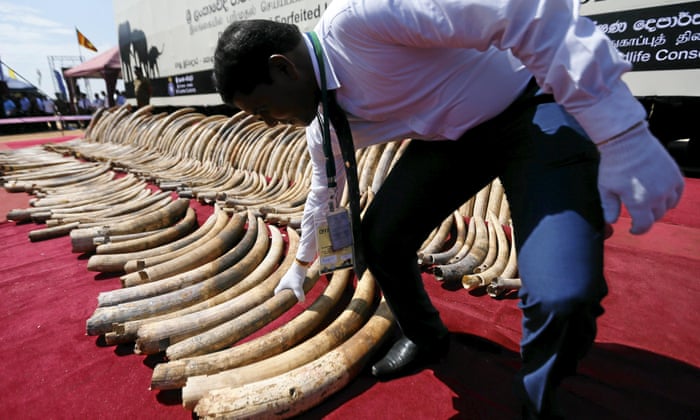
On Monday, the Sri Lankan government destroyed 359 elephant tusks in a huge stone crusher. The haul, confiscated at the port of Colombo and valued at more than $3m, was destroyed in the latest effort to remove ivory from the illegal wildlife trade.