TAIWAN ELECTS FIRST FEMALE PRESIDENT.
Taiwan elects its first female president; China warns of 'grave challenges'
 Taiwan has elected its first female president in a landmark election that could unsettle relations with Beijing.


Tsai
Ing-wen, leader of the opposition Democratic Progressive Party (DPP),
won the presidency with 56.1% of the vote, the official Central News Agency said, after eight years under the government of the pro-China Kuomintang (KMT) or Nationalist Party.
Eric
Chu, the Nationalist Party candidate in Taiwan's presidential election
conceded defeat late Saturday and congratulated rival Tsai Ing-wen on
her victory, the agency added.
Her supporters filled streets, waving party banners and cheering to victory announcements made from a stage.
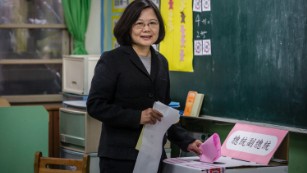
Democratic Progressive Party presidential candidate Tsai Ing-wen casts her ballot.
The
election also marked the first time the KMT has lost control of the
island's legislature. The DPP took 68 of the 113 seats in Taiwan's
parliament compared to the DPP's 35.
At a post-election news conference, Tsai underscored Taiwan's commitment to democracy, calling it a value "deeply engrained in the Taiwanese people."
"Our democratic way of life is forever the resolve of Taiwan's 23 million people," she said.
But
later in her speech, she also acknowledged the tenuous relationship
with Beijing, saying both sides "have a responsibility to do their
utmost to find mutually acceptable ways to interact ... and ensure no
provocation and no surprises."
'Grave challenges'
An editorial carried on China's official Xinhua news agency said there was "no denying that the DPP's return rule poses grave challenges to cross-strait relations."
And a statement from China's Taiwan Affairs Office quoted by Xinhua said it resolutely opposed "any form of secessionist activities seeking 'Taiwan independence.'"
Tsai's DPP has traditionally leaned in favor of independence for the island from mainland China.
That
could anger Beijing, which views Taiwan as an integral part of its
territory that is to be taken by force if necessary. Beijing has
missiles pointed at the island.
"I
voted for DPP, because it's very critical time for the Taiwan people. We
have our own democracy systems, we will not be influenced by China,"
said Tsai Cheng-an, a 55-year-old Taipei professor.
The KMT forged closer ties with China
under President Ma Ying-jeou. The new president will take over from Ma,
who will step down on May 20 after serving two four-year terms.
China
and Taiwan -- officially the People's Republic of China and the
Republic of China -- separated in 1949 following the Communist victory
on the mainland in the civil war.

The two sides have been governed
separately since, though a shared cultural and linguistic heritage
mostly endures -- with Mandarin spoken as the official language in both
places.
The sides have agreed since
1992 on a "one China" policy, in which both governments claim
sovereignty over mainland China and Taiwan -- but crucially neither
recognizes the other's legitimacy.
"I
voted for KMT because they are less likely to provoke cross-strait
troubles. They want peace. That's why I chose them. We've lived through
war, and it was not easy," said Chen, 83, a military veteran who
declined to give his full name.
Taiwan's
freewheeling democracy stands in sharp contrast to China's one-party
state, and a cast of colorful candidates are contesting seats -- they
include an ex-convict, an alleged spy and the front man of Asia's biggest death metal band.
Pop star's apology stirs anger
The
strained relationship was highlighted over the weekend when teenage pop
star Chou Tzu-yu made an apology for holding a Republic of China flag
on South Korean TV, setting off a national debate.
From
Taiwan, she is part of the South Korean pop act Twice. She appears in
the video reading her apology off a sheet of paper, leading many to
speculate that her Korean management company JYP Entertainment had
coerced her to appease mainland Chinese fans, who represent a lucrative
market.
There is only "one China", Chou said, and she will be taking a break from all China appearances to reflect on her actions.
The video even garnered a mention from Tsai in her victory speech, saying it "has shaken Taiwanese society."
"This
particular incident will serve as a constant reminder to me about the
importance of our country's strength and unity to those outside our
borders. This will be one of the most important responsibilities for me
as the next president of the Republic of China," Tsai said.
Balancing act
Tsai,
a soft-spoken U.S.-educated lawyer, is viewed as a pragmatic leader but
will have her work cut out balancing the interests of China, which is
the island's biggest trading partner, the United States, its key ally,
and the diverse demands of the island's 23 million residents.
In
particular, a younger generation fears a future under the influence of
Beijing and doesn't want Taiwan to become another Chinese territory.
"Taiwanese people are very peaceful. We
want a peaceful relationship with mainland China, but that shouldn't
mean we have to sacrifice our way of life and our democracy," said Huang
Kuo-chang, leader of the New Power Party, one of a number of smaller
opposition parties.
His party emerged
from 2014's "Sunflower Movement," when scores of student protesters
stormed and occupied Taiwan's Legislature and Cabinet building to object
to a trade pact that symbolized Taiwan's deepening relations with
mainland China.
The economy is a
particular concern for many young people, with unemployment standing at
12% among 20- to 24-year-olds -- three times the overall jobless rate,
according to official statistics.

Tidak ada komentar:
Posting Komentar