CHINA'S FILM INDUSTRY GOES GLOBAL.
Can China's movie industry take on Hollywood?

Hengdian, China (CNN)An
elderly man cries out in pain during a brutal interrogation in 1940's
China. A short stroll further on, a wife sobs outside an ancient
Chinese palace.
Down
the steps from her an army battalion rushes into battle, and just around
the corner, a martyr is executed during the Qing Dynasty.
If you were able to ignore the movie cameras and lighting rigs you might actually think you traveled back in time.
But
in reality, you've just come to Hengdian World Studios, the largest
studio complex in China. Dozens of movies and TV shows are produced out
of its lots all year long.
Most of the sets are historical replicas of times past.
Think
of a village in the Qing dynasty or a Hong Kong street in 1940. There
is even a to-scale replica of Beijing's famous Forbidden City.
Going global
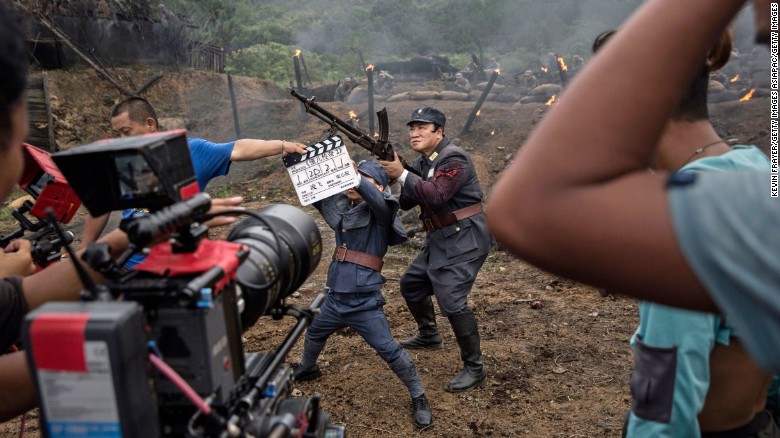
A war film is shot in Hengdian, China on August 11, 2015.
It is movie production on a Chinese scale, which is to say it is large and ever-expanding.
In
2015, Chinese-made films grossed over $4 billion, a nearly 70% jump
from the year before, according to Artisan Gateway, an Asian film
consultancy.
"The economy has developed
and people are getting richer," said Zhang Pu'an, a film director who
spoke to CNN while filming his latest project in Hengdian.
"So they're spending more and more money on entertainment. It's inevitable."
Zhang,
who's directed films for 20 years, remembers when that wasn't the case.
Now, he says China's film industry is ready to go global.

Two actresses walk through a set at Hengdian World Studios when CNN visited on December 29, 2015.
Growing footprint
China's footprint in Hollywood is growing.
On Tuesday, Dalian Wanda Group, the Chinese real estate and entertainment giant, bought a controlling stake in Legendary Pictures, a major Hollywood studio that financed films like "Jurassic World."
The deal is worth $3.5 billion dollars, and is the largest ever of its kind."
At the announcement, Wang Jianlin, the
company's chairman and China's richest man, said the acquisition will
allow greater distribution of Chinese films to international audiences.
Given
that Wanda also owns AMC theaters, the second largest U.S. cinema
chain, it's the kind of deal that could help introduce Chinese made
films to a different audience.
"If you want to make money, you need to make people like your movies," Wang said Tuesday.
"Right
now Chinese-made films don't generate enough interest in America to be
shown there. For that to happen, Chinese movies will have to find ways
to entertain American audiences. It's just how this process works."
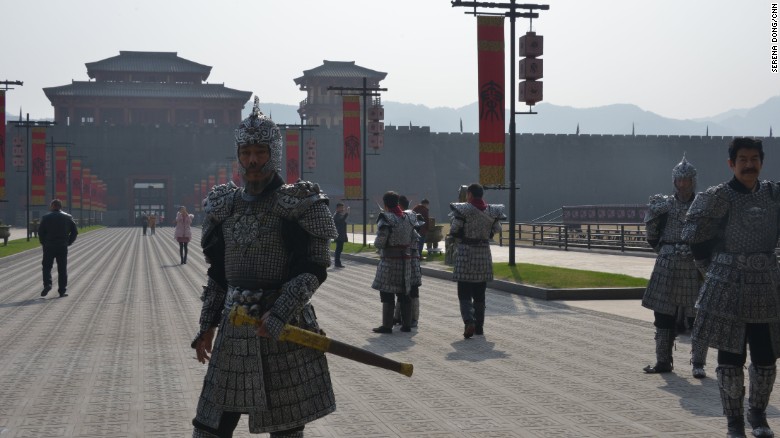
An actor on a Qing Dynasty set of China's biggest movie lot December 29, 2015.
Lofty goals
Beijing
allows a limited number of foreign films into China each year. Last
year, they grossed about $2.5 billion. But of the top ten highest box
office earners, only three came from overseas.
"Fast
and Furious 7," the latest Avengers installment "Age of Ultron, and
"Jurassic World" each did well, but none grossed more in Chinese
theaters than "Monster Hunt," a Chinese-made comedy.
"Hollywood is highly industrialized but it won't be number one for long," said Zhang, the director.
But to compete with Hollywood, China will have to start exporting its films around the world.
Tuesday's deal is just the start. It will have to build up its own mega-stars and bring in "Star Wars"-like profits.
For China, at least for now, those are lofty goals that are far, far away.

Tidak ada komentar:
Posting Komentar